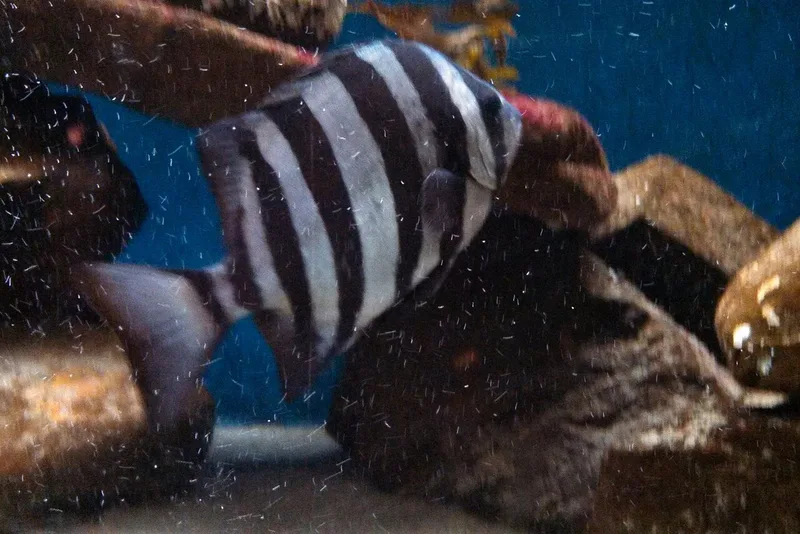
The classic big fish of the rocky shore. Juveniles, called shimadai, turn up on piers, but the large ones belong to serious rock fishing.
About
A rocky-reef fish wearing seven bold black bars on a pale body, found along coasts washed by warm currents. Its upper and lower teeth are fused into a beak strong enough to crush shellfish and sea urchins. Old males lose the bars and darken around the mouth, earning the name kuchiguro, black-mouth. The related spotted knifejaw is covered in fine dark speckles instead of bars.
Basics
Scientific name
Oplegnathus fasciatus
Family
イシダイ科
Japanese name
イシダイ
Kana
いしだい
Also called
シマダイ, サンバソウ
Waters
Sea of Japan, Southern Pacific coast, East China Sea & western Kyushu
Size
40 cm (max 80 cm)
Time of day
Dawn, Daytime
Depth (tana)
On the bottom, and the rougher the ground the bigger the fish: submerged rock edges and the white water of breaking waves.
Local names
サンバソウ, クチグロ
Ad slot
How to catch it
The classic rocky-shore bottom quarry. Anglers use sea urchin or turban snail on a wire leader with a stout dedicated rod and conventional reel. The spring spawning run and the autumn feeding spree are the peak times.
A bottom fishery: place the rig against submerged rock, set the rod in a holder, and wait. The urchins and shellfish used as bait are usually covered by fishery rights, so buy them or obtain permission.
Waters: Sea of Japan, Southern Pacific coast, Seto Inland Sea, East China Sea & western Kyushu
The boldly striped juveniles, called shimadai, come to the piers in summer. Even a small one has powerful teeth, so keep your fingers out when unhooking it.
Waters: Sea of Japan, Southern Pacific coast, Seto Inland Sea, East China Sea & western Kyushu
Kit for this fish
Surf casting kit ・ Kit total ¥22,000–60,000
Surf rod, 4.25 m, 27-gouA true surf rod for launching heavy sinkers to distant ground. Always check behind you before casting.¥8,000–30,000AdFind on AmazonFind on Rakuten
Spinning reel, size 3000For surf casting and live-bait fishing: holds more line and stands up to mid-sized fish.¥5,000–18,000AdFind on AmazonFind on Rakuten
Nylon line, 3-gou (about 12 lb)For sabiki and hole fishing. Thick enough to resist abrasion on rock and to horse a rockfish straight up.¥600–2,000AdFind on AmazonFind on Rakuten
Jet tenbin sinker, 15-25 gouThe long-range sinker for surf casting. It lifts as you retrieve, which reduces snags.¥300–900AdFind on AmazonFind on Rakuten
Whiting rig (2-3 hooks)A surf rig of small, fine-wire hooks matched to the small mouth of Japanese whiting.¥300–900AdFind on AmazonFind on Rakuten
Flounder rig (single-arm sinker, 2 hooks, attractor beads)A winter surf rig; the fluorescent beads make it visible in coloured water.¥400–1,200AdFind on AmazonFind on Rakuten
Aoisome (green sandworm / Nereis)The most versatile worm bait, usable for chonage, surf, hole and float fishing alike. Its movement is the attraction, so do not cut it too short.¥500–1,200AdFind on AmazonFind on Rakuten
Rod stand / tripodFor resting a rod during surf fishing. A rod laid on the ground damages its guides and can be washed away.¥2,000–10,000AdFind on AmazonFind on Rakuten
Cool box, 15-20 LFor carrying fish home cold. Take plenty of ice; in summer a poorly insulated box is not fit for the job.¥4,000–25,000AdFind on AmazonFind on Rakuten
Life jacket, adult (Japan Craft Inspection approved)The first thing to buy, and worn on piers, rocks and boats alike. Boat fishing requires the government-approved type marked with the cherry-blossom stamp.¥5,000–20,000AdFind on AmazonFind on Rakuten
Cap and polarised sunglassesAlso safety equipment, protecting your eyes from a flying rig. Polarised lenses additionally let you read the bottom.¥2,000–20,000AdFind on AmazonFind on Rakuten
You are swinging a heavy sinker, so checking behind you and keeping distance from others is the core of safety here. The cap and glasses are included as eye protection.
Product links may be affiliate links. Prices move, so treat the ranges as a guide.
Its teeth are fused into plates strong enough to crush sea urchins and turban shells, and a finger placed in its mouth can be injured to the bone. Always unhook it with pliers.
Sashimi or arai. A firm white flesh; large fish command high prices.
Best eating: July–October
Rules
The sea urchins and shellfish used as bait are usually covered by fishery rights, and taking them yourself can be an offence. Buy your bait, or get permission from the local cooperative.