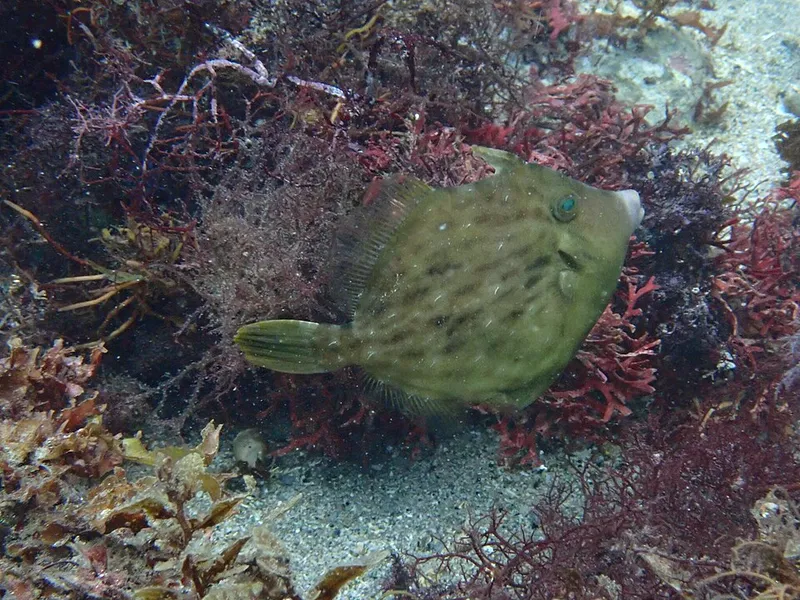
Numbers come in summer, while size and liver improve from autumn into winter. The fish thins before spawning in spring and feeds hard in early summer, so it has two seasons: one for the flesh and one for the liver.
About
A diamond-shaped, laterally flattened fish, blue-grey to brown with faint mottling. Its name means "skin peeler": the rough hide strips off by hand. Males can be told from females by the second dorsal ray, which trails out like a thread. Its tiny puckered mouth makes it an expert bait thief, and the liver — fattest in autumn and winter — is prized as the foie gras of the sea.
Basics
Scientific name
Stephanolepis cirrhifer
Family
Monacanthidae (Filefishes)
Japanese name
カワハギ
Kana
かわはぎ
Also called
ハゲ, マルハゲ, ハギ
Waters
Northern Pacific coast, Southern Pacific coast, Seto Inland Sea, East China Sea & western Kyushu
Size
22 cm (max 30 cm)
Time of day
Dawn, Daytime
Depth (tana)
From the bottom up to about 30 cm, where sand meets rock and along rip-rap. It responds better to a sinker tapped continuously on the bottom than to a rig held still.
Local names
ハゲ, ハゲ
Ad slot
How to catch it
From a boat the standard is a dropper rig baited with shucked asari clam, peaking from October to December. It can also be worked close in along breakwaters. Notorious for stripping the bait without getting hooked.
Chonage (short-cast bottom fishing) from a Breakwater / Pier
It is normal for the bait to vanish without a bite ever registering. Drop to a small filefish hook, around size four, and cut the bait to a centimetre with nothing hanging off. Tap the sinker on the bottom and lift into the moment the rod tip springs back.
On a day when the krill disappears without the float ever moving, this is usually the culprit. Read the faint pre-bite through the rod tip rather than the float, and if you still cannot hook it, go down a hook size and bury the hook in the bait. It gathers along weed edges.
Waters: Southern Pacific coast, Seto Inland Sea, East China Sea & western Kyushu
Kit for this fish
Chonage starter kit ・ Kit total ¥11,000–24,000
Compact all-round rod, 2.4 mThe entry rod for chonage and light bottom fishing. It packs down to about 50 cm, so it travels by train, and a child can swing it.¥2,500–6,000AdFind on AmazonFind on Rakuten
Spinning reel, size 1000-2000A small reel for chonage, hole fishing and light work. Light enough for a child to hold.¥2,500–8,000AdFind on AmazonFind on Rakuten
Nylon line, 2-gou (about 8 lb)The standard for chonage and float fishing. Its stretch absorbs sudden runs and forgives an imperfect knot.¥600–2,000AdFind on AmazonFind on Rakuten
Chonage rig set (sinker arm + 2 hooks)A pack with the sinker arm, weight and hooks together; you only have to tie one knot to the main line.¥300–900AdFind on AmazonFind on Rakuten
Jarime (small sandworm)Thinner than aoisome and better matched to the small mouths of whiting and goby.¥500–1,200AdFind on AmazonFind on Rakuten
Rope bucket for drawing seawaterUsed to rinse hands and chum and to keep fish alive. It is also how you leave the pier clean.¥800–2,500AdFind on AmazonFind on Rakuten
Fishing pliers / hook removerEssential protection from venomous spines and sharp teeth. Most injuries happen when someone unhooks a fish bare-handed.¥800–4,000AdFind on AmazonFind on Rakuten
Cool box, 15-20 LFor carrying fish home cold. Take plenty of ice; in summer a poorly insulated box is not fit for the job.¥4,000–25,000AdFind on AmazonFind on Rakuten
Life jacket, adult (Japan Craft Inspection approved)The first thing to buy, and worn on piers, rocks and boats alike. Boat fishing requires the government-approved type marked with the cherry-blossom stamp.¥5,000–20,000AdFind on AmazonFind on Rakuten
A compact rod travels by train. Jarime is the easiest bait to handle.
Product links may be affiliate links. Prices move, so treat the ranges as a guide.
The first dorsal spine is thick and locks upright once raised. It goes deep into the palm of a hand closed around the fish, so look at where the spine is before you take hold.
The point of it is sashimi with the liver whisked into the soy. The liver swells from autumn into winter and is small in summer; do not use liver that is past its best, and slice the flesh thin.
Best eating: January, June–August, November, December
Rules
Some prefectures set a minimum size in their fishery regulations. Check the rules where you are going.