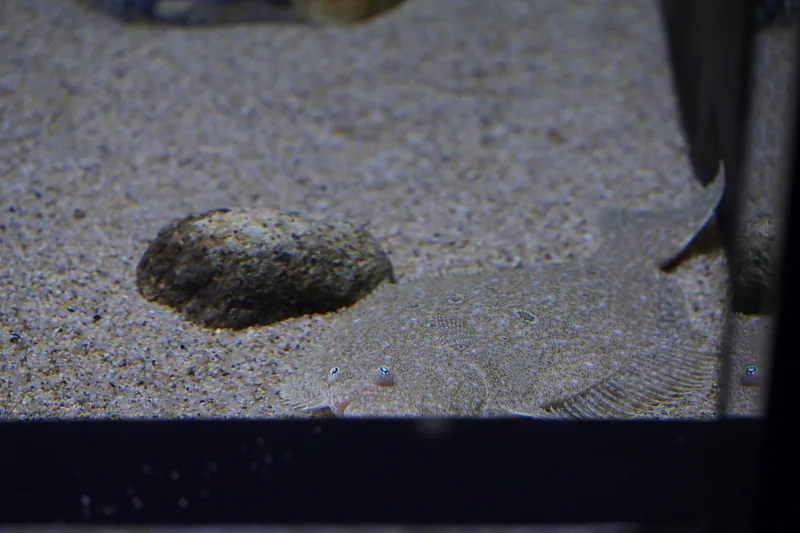
Prime from autumn into winter, when the baitfish are inshore. It is one of the largest fish reachable with a live bait from a pier, and hooking one is not something you forget.
About
A Japanese saying, hirame to the left and karei to the right, describes it well: hold it belly toward you and both eyes are on the left. Its mouth is larger than a righteye flounder's and each tooth is big and sharp. It reaches 1 m and 10 kg, and about nine tenths of an adult's diet is small fish, ambushed from the sand as it matches its colour to the bottom. The muscle along the fin base, engawa, is a delicacy.
Basics
Scientific name
Paralichthys olivaceus
Family
ヒラメ科
Japanese name
ヒラメ
Kana
ひらめ
Waters
Hokkaido & Sea of Okhotsk, Sea of Japan, Northern Pacific coast, Southern Pacific coast, East China Sea & western Kyushu
Size
50 cm (max 100 cm)
Time of day
Dawn, Dusk
Depth (tana)
About a metre off the bottom. It lies in the sand and strikes upward at passing baitfish, so keep the live bait just clear of the seabed.
Local names
常磐もの
Ad slot
How to catch it
Lure fishing from surf beaches is popular, casting minnows and jigs; from breakwaters, small live horse mackerel are drifted as bait. Spring and autumn are the peak seasons.
Do not strike on the first tap. A flounder holds the bait before swallowing it, so wait ten to thirty seconds before lifting the rod; the Japanese saying puts the count at forty.
Waters: Hokkaido & Sea of Okhotsk, Sea of Japan, Northern Pacific coast, Southern Pacific coast, East China Sea & western Kyushu
Nomase (live bait) fishing from a Breakwater / Pier
Use a small horse mackerel straight from your sabiki rig. Wet your hands before touching it, hook it quickly through the nose or back, and always net the fish rather than lifting it.
Waters: Hokkaido & Sea of Okhotsk, Sea of Japan, Northern Pacific coast, Southern Pacific coast, East China Sea & western Kyushu
Retrieve just off the bottom, letting the jig touch down periodically. Fish sit beside outflows and rip currents, so read the beach and cast at the changes. The teeth are sharp: remove hooks with pliers.
Waters: Sea of Japan, Northern Pacific coast, Southern Pacific coast, East China Sea & western Kyushu
Kit for this fish
Live-bait fishing kit ・ Kit total ¥25,000–60,000
Isozao #4-5, 4.5 mFor live-bait (nomase) fishing: strong enough to cast a live baitfish and to stop a running jack.¥8,000–25,000AdFind on AmazonFind on Rakuten
Spinning reel, size 3000For surf casting and live-bait fishing: holds more line and stands up to mid-sized fish.¥5,000–18,000AdFind on AmazonFind on Rakuten
Nylon line, 5-gou (about 20 lb)Main line for live-bait fishing, giving margin once something large is on.¥800–2,500AdFind on AmazonFind on Rakuten
Live-bait rig (elevator or float type)Designed to let a live baitfish swim without tiring. The elevator type slides the bait down the main line, so you never have to recast it.¥400–1,500AdFind on AmazonFind on Rakuten
Rope bucket for drawing seawaterUsed to rinse hands and chum and to keep fish alive. It is also how you leave the pier clean.¥800–2,500AdFind on AmazonFind on Rakuten
Landing net with 5 m handlePiers sit high above the water and heavy fish break off if you lift them. Having one changes what you land.¥4,000–20,000AdFind on AmazonFind on Rakuten
Knife and spike for bleeding fishWhat turns a caught fish into good food; bleeding it changes the taste. See the column "Killing and carrying your catch" for how to use them.¥1,000–6,000AdFind on AmazonFind on Rakuten
Cool box, 15-20 LFor carrying fish home cold. Take plenty of ice; in summer a poorly insulated box is not fit for the job.¥4,000–25,000AdFind on AmazonFind on Rakuten
Life jacket, adult (Japan Craft Inspection approved)The first thing to buy, and worn on piers, rocks and boats alike. Boat fishing requires the government-approved type marked with the cherry-blossom stamp.¥5,000–20,000AdFind on AmazonFind on Rakuten
The bait is normally caught on site with a sabiki rig, so bring that kit too. You need a bucket, ideally aerated, to keep the bait alive.
Product links may be affiliate links. Prices move, so treat the ranges as a guide.