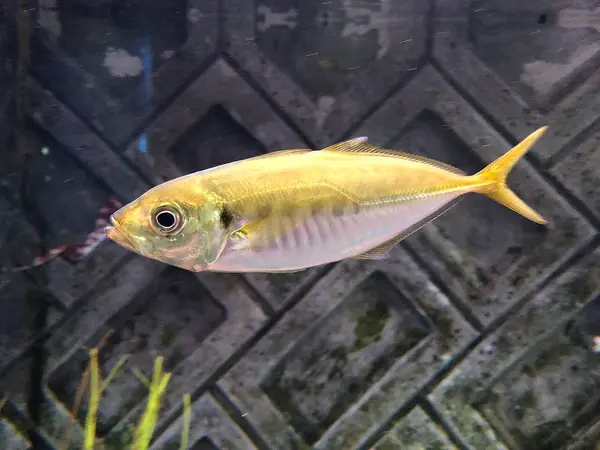
Schools of small fish come to the piers from early summer to autumn and are easy to catch on sabiki rigs. Better fish come at night on float rigs, and small ones are prized as live bait.
About
The row of spiny scutes called zeigo runs the entire length of the lateral line, the surest way to tell it from round scad, which has them only on the rear half. The lateral line itself dips sharply downward near mid-body, and there is a dark blotch on the upper edge of the gill cover. Inshore residents are yellowish and deep-bodied, while migratory offshore fish are darker and slimmer. Best in summer, it turns up as everything from sashimi to dried fillets.
Basics
Scientific name
Trachurus japonicus
Family
Carangidae (Jacks)
Japanese name
マアジ
Kana
まあじ
Also called
アジ, 豆アジ, まめあじ
Waters
Sea of Japan, Northern Pacific coast, Southern Pacific coast, Seto Inland Sea, East China Sea & western Kyushu
Size
25 cm (max 50 cm)
Time of day
Dawn, Dusk, Night
Depth (tana)
Surface to mid-water. With a sabiki rig, work the wall at your feet; if the school is up, fish just under the surface.
Ad slot
How to catch it
Sabiki rigs, a string of small hooks worked through ground bait, are the classic beginner's fishery off breakwaters, and summer night sessions are a seasonal fixture. Boat anglers chum with minced sardine and fish a boom-and-sinker rig all year.
Sabiki (bait-jig) fishing from a Breakwater / Pier
Shake the cage to release the krill, then hold the rig still inside that cloud. Everything depends on keeping the school at your feet, so the more often you refill the cage, the more you catch.
The better fish, a size up from what the sabiki rigs produce, come out around the harbour lights after dark. Start at about three fathoms and, if nothing happens, shorten by 50 cm at a time.
Waters: Sea of Japan, Northern Pacific coast, Southern Pacific coast, Seto Inland Sea, East China Sea & western Kyushu
Kit for this fish
Sabiki starter kit ・ Kit total ¥14,000–32,000
Isozao (telescopic shore rod) #3, 3.6 mThe standard rod for sabiki and float fishing. Telescopic, so it packs short and handles easily on a pier. If you buy one rod, buy this.¥4,000–9,000AdFind on AmazonFind on Rakuten
Spinning reel, size 2500The most versatile size for pier fishing: one reel covers sabiki, float fishing and eging.¥4,000–15,000AdFind on AmazonFind on Rakuten
Nylon line, 3-gou (about 12 lb)For sabiki and hole fishing. Thick enough to resist abrasion on rock and to horse a rockfish straight up.¥600–2,000AdFind on AmazonFind on Rakuten
Sabiki rig (hook size 3-6)A ready-made string of feathered hooks. Match the hook size to the fish: 3 for small horse mackerel, 6 for better ones.¥200–600AdFind on AmazonFind on Rakuten
Krill cage with sinker (for sabiki)The cage you pack with krill to release chum. Bottom-cage versions are the easier choice from a pier.¥200–800AdFind on AmazonFind on Rakuten
Frozen krill, amiebi (block or tube)The chum for sabiki fishing. The tube type needs no thawing and keeps your hands clean, which suits families.¥300–1,200AdFind on AmazonFind on Rakuten
Rope bucket for drawing seawaterUsed to rinse hands and chum and to keep fish alive. It is also how you leave the pier clean.¥800–2,500AdFind on AmazonFind on Rakuten
Fishing pliers / hook removerEssential protection from venomous spines and sharp teeth. Most injuries happen when someone unhooks a fish bare-handed.¥800–4,000AdFind on AmazonFind on Rakuten
Cool box, 15-20 LFor carrying fish home cold. Take plenty of ice; in summer a poorly insulated box is not fit for the job.¥4,000–25,000AdFind on AmazonFind on Rakuten
Life jacket, adult (Japan Craft Inspection approved)The first thing to buy, and worn on piers, rocks and boats alike. Boat fishing requires the government-approved type marked with the cherry-blossom stamp.¥5,000–20,000AdFind on AmazonFind on Rakuten
Always include the life jacket, and add the child version if you are bringing children. This kit alone is enough to start.
Product links may be affiliate links. Prices move, so treat the ranges as a guide.