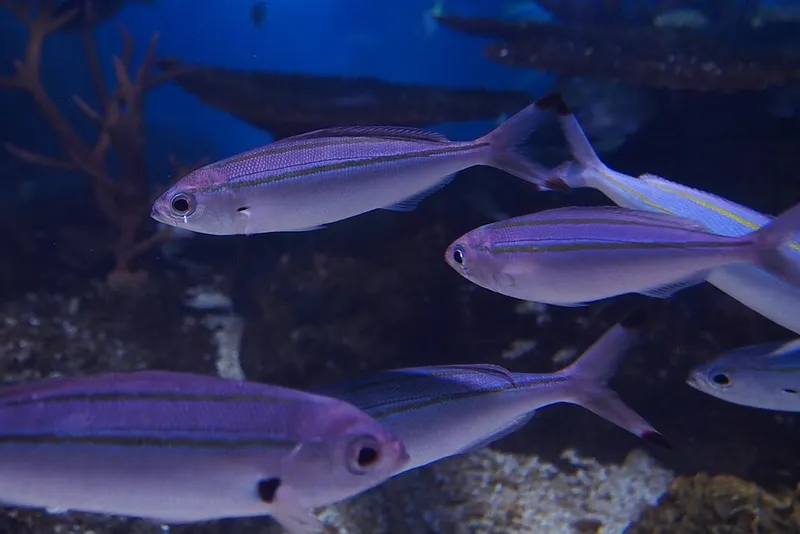
In Okinawa it is caught all year, though the schools thicken from early summer into autumn as the water warms. It is the prefectural fish, and sabiki rigs take numbers of it from both breakwaters and boats. Mainland seasons do not apply here.
About
The official fish of Okinawa Prefecture, where it is known and loved as "gurukun." Blue-green in life, it turns red once dead. Deep-frying is the classic preparation.
Basics
Scientific name
Pterocaesio digramma
Family
タカサゴ科
Japanese name
タカサゴ
Kana
たかさご
Also called
グルクン
Waters
Okinawa & Nansei Islands, Southern Pacific coast
Size
25 cm (max 30 cm)
Time of day
Dawn, Daytime, Dusk
Depth (tana)
From mid-water down to just above the bottom: over reef in 15 to 40 metres from a boat, and inside the chum trail off a pier end where the current runs.
Local names
グルクン, グルクン
Ad slot
How to catch it
In Okinawa it is usually taken on sabiki rigs from a boat in 15 to 40 metres of water, with big catches from spring to autumn. It is also caught from breakwaters and rocky shores.
Over reef in 15 to 40 metres, find the bottom, work the rod to shake krill out of the cage, then hold still for a few seconds, and repeat. When one hooks up, leave it down to draw others onto the rig before winding. Use the sinker weight the boat specifies.
Fish the end of a breakwater where the current runs, and use chum to bring the school within reach. If nothing shows near the top, drop all the way down and search the layers. The sun here is fierce: bring a hat, polarised glasses and more water than you think you need.
Isozao (telescopic shore rod) #3, 3.6 mThe standard rod for sabiki and float fishing. Telescopic, so it packs short and handles easily on a pier. If you buy one rod, buy this.¥4,000–9,000AdFind on AmazonFind on Rakuten
Spinning reel, size 2500The most versatile size for pier fishing: one reel covers sabiki, float fishing and eging.¥4,000–15,000AdFind on AmazonFind on Rakuten
Nylon line, 3-gou (about 12 lb)For sabiki and hole fishing. Thick enough to resist abrasion on rock and to horse a rockfish straight up.¥600–2,000AdFind on AmazonFind on Rakuten
Sabiki rig (hook size 3-6)A ready-made string of feathered hooks. Match the hook size to the fish: 3 for small horse mackerel, 6 for better ones.¥200–600AdFind on AmazonFind on Rakuten
Krill cage with sinker (for sabiki)The cage you pack with krill to release chum. Bottom-cage versions are the easier choice from a pier.¥200–800AdFind on AmazonFind on Rakuten
Frozen krill, amiebi (block or tube)The chum for sabiki fishing. The tube type needs no thawing and keeps your hands clean, which suits families.¥300–1,200AdFind on AmazonFind on Rakuten
Rope bucket for drawing seawaterUsed to rinse hands and chum and to keep fish alive. It is also how you leave the pier clean.¥800–2,500AdFind on AmazonFind on Rakuten
Fishing pliers / hook removerEssential protection from venomous spines and sharp teeth. Most injuries happen when someone unhooks a fish bare-handed.¥800–4,000AdFind on AmazonFind on Rakuten
Cool box, 15-20 LFor carrying fish home cold. Take plenty of ice; in summer a poorly insulated box is not fit for the job.¥4,000–25,000AdFind on AmazonFind on Rakuten
Life jacket, adult (Japan Craft Inspection approved)The first thing to buy, and worn on piers, rocks and boats alike. Boat fishing requires the government-approved type marked with the cherry-blossom stamp.¥5,000–20,000AdFind on AmazonFind on Rakuten
Always include the life jacket, and add the child version if you are bringing children. This kit alone is enough to start.
Product links may be affiliate links. Prices move, so treat the ranges as a guide.
Deep-fried whole is the standard, bones and all. It spoils fast, so sashimi is for the day you catch it. The blue-green of a living fish turns red once it dies.
Best eating: June–September
Rules
Check Okinawa's prefectural fishery regulation. Parts of many harbours are closed to entry or to fishing, so follow the signage on site.