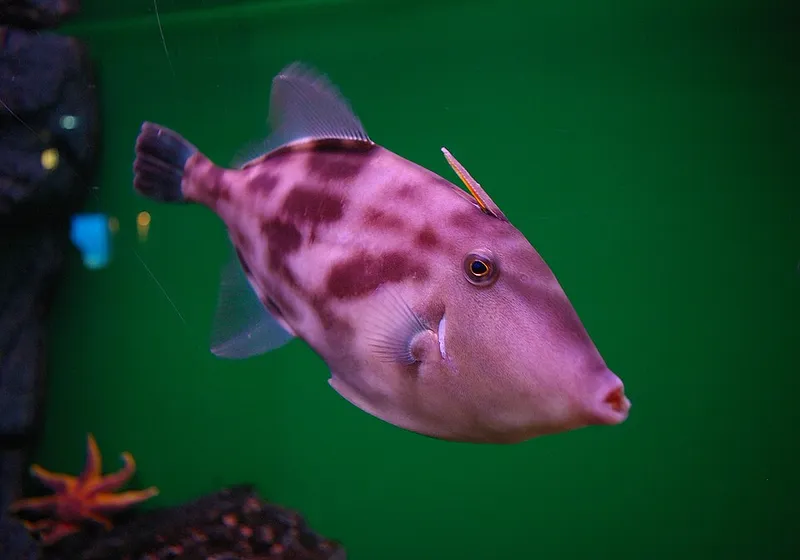
It moves in schools, so when they arrive you take several in a row. From breakwaters there are two runs, spring to early summer and late autumn into winter, and the liver is at its largest as the water cools from November to January.
About
Longer-faced than the thread-sail filefish, which is how it got a Japanese name meaning "horse face." It is blue-gray, and popular dried or in hot pot.
Basics
Scientific name
Thamnaconus modestus
Family
Monacanthidae (Filefishes)
Japanese name
ウマヅラハギ
Kana
うまづらはぎ
Also called
ウマヅラ, ハゲ, ナガハゲ
Waters
Sea of Japan, Southern Pacific coast, Seto Inland Sea, East China Sea & western Kyushu
Size
28 cm (max 40 cm)
Time of day
Dawn, Daytime
Depth (tana)
Mid-water. Unlike its relative it does not sit on the bottom but rises into the chum cloud as a school, so note the depth at which you hooked one and hold there.
Ad slot
How to catch it
Fished from breakwaters and boats on a dropper rig baited with clam or krill. It is a skilled bait thief, so detecting the bite is the sport of it.
Start with the float set at about three fathoms and use chum to lift the school. Pinch the head off the krill, thread it right up the shank, and lift while there is still bait on the hook. Swapping to a small filefish hook changes how many bites you convert.
Schools barge into a sabiki rig meant for horse mackerel. When they keep mouthing the lures without hooking up, thread a single krill onto the bottom hook and they take properly. The teeth are strong enough to part the main line.
Waters: Sea of Japan, Southern Pacific coast, Seto Inland Sea, East China Sea & western Kyushu
Kit for this fish
Float fishing starter kit ・ Kit total ¥13,000–30,000
Isozao (telescopic shore rod) #3, 3.6 mThe standard rod for sabiki and float fishing. Telescopic, so it packs short and handles easily on a pier. If you buy one rod, buy this.¥4,000–9,000AdFind on AmazonFind on Rakuten
Spinning reel, size 2500The most versatile size for pier fishing: one reel covers sabiki, float fishing and eging.¥4,000–15,000AdFind on AmazonFind on Rakuten
Nylon line, 2-gou (about 8 lb)The standard for chonage and float fishing. Its stretch absorbs sudden runs and forgives an imperfect knot.¥600–2,000AdFind on AmazonFind on Rakuten
Float rig set (stick float / cone float)A pack with float, stopper, split shot and hook. It is all you need to start practising depth changes.¥500–1,500AdFind on AmazonFind on Rakuten
Okiami krill (raw or boiled)The hook bait for float and fukase fishing. Boiled stands up to bait thieves; raw gets more bites.¥400–1,200AdFind on AmazonFind on Rakuten
Rope bucket for drawing seawaterUsed to rinse hands and chum and to keep fish alive. It is also how you leave the pier clean.¥800–2,500AdFind on AmazonFind on Rakuten
Fishing pliers / hook removerEssential protection from venomous spines and sharp teeth. Most injuries happen when someone unhooks a fish bare-handed.¥800–4,000AdFind on AmazonFind on Rakuten
Cool box, 15-20 LFor carrying fish home cold. Take plenty of ice; in summer a poorly insulated box is not fit for the job.¥4,000–25,000AdFind on AmazonFind on Rakuten
Life jacket, adult (Japan Craft Inspection approved)The first thing to buy, and worn on piers, rocks and boats alike. Boat fishing requires the government-approved type marked with the cherry-blossom stamp.¥5,000–20,000AdFind on AmazonFind on Rakuten
Shares the rod and reel with the sabiki kit. The whole craft is in moving the stopper to find the depth.
Product links may be affiliate links. Prices move, so treat the ranges as a guide.
The first dorsal spine locks once it is raised, and this being the larger fish, the spine is heavier than a filefish's. Fold it down before you take hold, or use a fish grip.
Usually taken in a hotpot or simmered. Thin-sliced with the big winter liver whisked into soy, it gives away little to its more famous relative. Pinch the edge of the skin and it peels off by hand.
Best eating: January, February, November, December