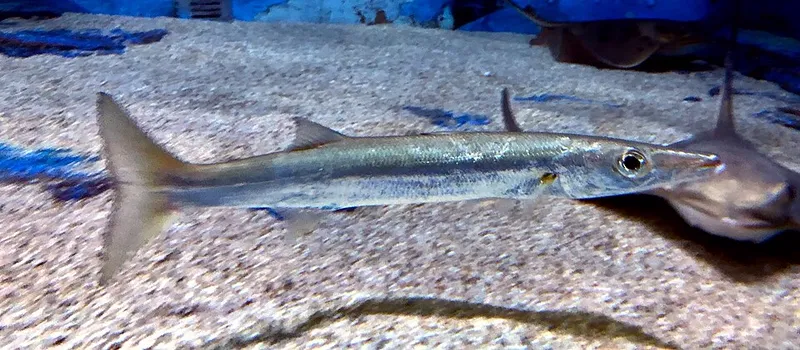
It follows the anchovy inshore from summer into autumn, hunting at dawn and dusk and around the harbour lights. It only fishes while a school is passing, so the window is sharp.
About
A slender predator with sharp teeth. It is superb dried, and overnight-dried barracuda is an autumn favourite. It hunts small fish in schools.
Basics
Scientific name
Sphyraena pinguis
Family
Sphyraenidae (Barracudas)
Japanese name
アカカマス
Kana
あかかますう
Also called
カマス, ホンカマス
Waters
Southern Pacific coast, East China Sea & western Kyushu, Sea of Japan
Size
30 cm (max 45 cm)
Time of day
Dawn, Dusk, Night
Depth (tana)
Surface to mid-water: just under the top right after sunset, then dropping to a little below the edge between light and dark under the lamps. Go to a heavier jig as they settle.
Ad slot
How to catch it
The run peaks from autumn to early winter. From breakwaters and fishing harbors, simply cast a kamasu sabiki rig and reel it back; float fishing with kibinago sprats is another standard. Dawn and dusk are the prime windows.
Hang a single kibinago sprat under an electric float set about a fathom deep and drift it along the edge of the lamplight. When the float goes under, wait a beat before striking. Those teeth mean a leader of at least size three.
Waters: Southern Pacific coast, East China Sea & western Kyushu, Sea of Japan
A ten-gram jig retrieved straight and fast is usually enough. If fish follow and turn away, stop the reel and let it drop once. A short kamasu sabiki rigged above the jig covers several depths in one cast.
Waters: Southern Pacific coast, East China Sea & western Kyushu, Sea of Japan
Kit for this fish
Float fishing starter kit ・ Kit total ¥13,000–30,000
Isozao (telescopic shore rod) #3, 3.6 mThe standard rod for sabiki and float fishing. Telescopic, so it packs short and handles easily on a pier. If you buy one rod, buy this.¥4,000–9,000AdFind on AmazonFind on Rakuten
Spinning reel, size 2500The most versatile size for pier fishing: one reel covers sabiki, float fishing and eging.¥4,000–15,000AdFind on AmazonFind on Rakuten
Nylon line, 2-gou (about 8 lb)The standard for chonage and float fishing. Its stretch absorbs sudden runs and forgives an imperfect knot.¥600–2,000AdFind on AmazonFind on Rakuten
Float rig set (stick float / cone float)A pack with float, stopper, split shot and hook. It is all you need to start practising depth changes.¥500–1,500AdFind on AmazonFind on Rakuten
Okiami krill (raw or boiled)The hook bait for float and fukase fishing. Boiled stands up to bait thieves; raw gets more bites.¥400–1,200AdFind on AmazonFind on Rakuten
Rope bucket for drawing seawaterUsed to rinse hands and chum and to keep fish alive. It is also how you leave the pier clean.¥800–2,500AdFind on AmazonFind on Rakuten
Fishing pliers / hook removerEssential protection from venomous spines and sharp teeth. Most injuries happen when someone unhooks a fish bare-handed.¥800–4,000AdFind on AmazonFind on Rakuten
Cool box, 15-20 LFor carrying fish home cold. Take plenty of ice; in summer a poorly insulated box is not fit for the job.¥4,000–25,000AdFind on AmazonFind on Rakuten
Life jacket, adult (Japan Craft Inspection approved)The first thing to buy, and worn on piers, rocks and boats alike. Boat fishing requires the government-approved type marked with the cherry-blossom stamp.¥5,000–20,000AdFind on AmazonFind on Rakuten
Shares the rod and reel with the sabiki kit. The whole craft is in moving the stopper to find the depth.
Product links may be affiliate links. Prices move, so treat the ranges as a guide.
Rows of fine, sharp teeth will open a finger while you unhook it, and they cut through leader and soft plastics alike. Keep your hand out of the mouth: hold the fish with a grip and take the hook with pliers.
The overnight-dried fillet is the best of it: salt it, hang it for a night, and it becomes another fish. The flesh is soft and spoils quickly, so sashimi is for the day of the catch only.
Best eating: September–December
Rules
Check the local prefectural fishery regulation. Many harbours are closed at night as well, so read the operator's signage.