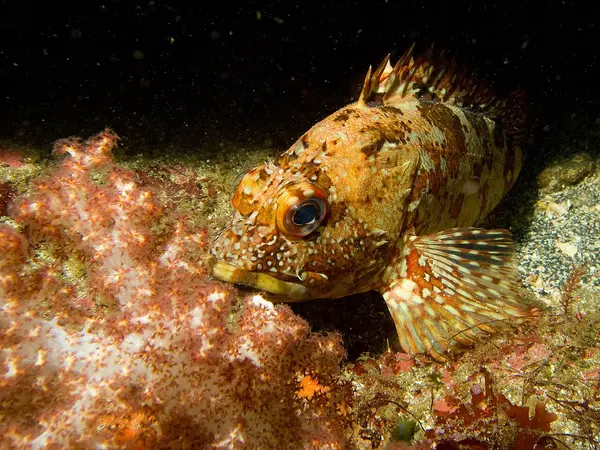
One of the few species that fishes all year, and the mainstay of midwinter hole fishing. It sits still in its hole, so the angler is the one who does the moving.
About
A big-mouthed rockfish that lurks among reefs, growing to about 30 cm. Its colour follows its habitat: brown in the shallows, vivid red in deeper water. The near-identical Sebastiscus tertius has brown-rimmed white spots and lives deeper and grows larger. It is ovoviviparous, releasing live young rather than eggs, and hides by day to forage at night.
Basics
Scientific name
Sebastiscus marmoratus
Family
メバル科
Japanese name
カサゴ
Kana
かさご
Also called
ガシラ, アラカブ, ホゴ, ボッコ
Waters
Sea of Japan, Southern Pacific coast, Seto Inland Sea, East China Sea & western Kyushu
Size
20 cm (max 30 cm)
Time of day
Dawn, Daytime, Dusk, Night
Depth (tana)
Hard on the bottom, always tight to structure such as gaps in tetrapods or the edge of rip-rap.
Local names
ガシラ, アラカブ, ホゴ, アラカブ, アラカブ, アラカブ, アラカブ, アラカブ
Ad slot
How to catch it
The standard approach is ana-zuri, or hole fishing: dropping a burakuri sinker-and-hook rig into gaps between tetrapods and breakwater blocks. Autumn and winter are prime, and snags are constant, so carry spare rigs.
Anazuri (hole fishing in tetrapods) from a Breakwater / Pier
Drop it, touch bottom, lift two or three times, and if nothing happens move on. The essence of this fishery is covering many holes rather than working one. When it takes, pull it straight up before it can get back into the rock.
Waters: Sea of Japan, Northern Pacific coast, Southern Pacific coast, Seto Inland Sea, East China Sea & western Kyushu
Chonage (short-cast bottom fishing) from a Breakwater / Pier
Fish the rip-rap at the base of the pier. It is snaggy ground, so carry plenty of cheap rigs. Always unhook with pliers and keep your fingers off the spines.
Waters: Sea of Japan, Northern Pacific coast, Southern Pacific coast, Seto Inland Sea, East China Sea & western Kyushu
Kit for this fish
Hole fishing kit ・ Kit total ¥12,000–28,000
Short hole-fishing rod, 1.2 mA short rod for dropping straight into gaps in the tetrapods. It is easy to handle and stiff enough to pull a fish out before it reaches its hole.¥2,000–6,000AdFind on AmazonFind on Rakuten
Spinning reel, size 1000-2000A small reel for chonage, hole fishing and light work. Light enough for a child to hold.¥2,500–8,000AdFind on AmazonFind on Rakuten
Nylon line, 3-gou (about 12 lb)For sabiki and hole fishing. Thick enough to resist abrasion on rock and to horse a rockfish straight up.¥600–2,000AdFind on AmazonFind on Rakuten
Burakuri (weighted single-hook jig), 3-8 gouA one-piece weight-and-hook rig for hole fishing. Drop it into a gap, tap the bottom, and draw the rockfish out.¥200–600AdFind on AmazonFind on Rakuten
Cut fish bait (saury, mackerel, sardine)For hole fishing, cutlassfish and larger rockfish. Salting the flesh firms it so it stays on the hook.¥300–900AdFind on AmazonFind on Rakuten
Fishing pliers / hook removerEssential protection from venomous spines and sharp teeth. Most injuries happen when someone unhooks a fish bare-handed.¥800–4,000AdFind on AmazonFind on Rakuten
Studded or felt-soled bootsOrdinary shoes slip on rock and tetrapods. Falls are the most common cause of accidents, so these are mandatory for rocky shores.¥4,000–15,000AdFind on AmazonFind on Rakuten
Life jacket, adult (Japan Craft Inspection approved)The first thing to buy, and worn on piers, rocks and boats alike. Boat fishing requires the government-approved type marked with the cherry-blossom stamp.¥5,000–20,000AdFind on AmazonFind on Rakuten
The cheapest tackle but the most dangerous footing. Do not skip the studded boots or the life jacket, and never step on wet tetrapods.
Product links may be affiliate links. Prices move, so treat the ranges as a guide.
The dorsal and gill-cover spines are sharp and go in deep if you grab the fish. It is not considered strongly venomous, but punctures can swell and become infected. Use a fish grip and pliers rather than your bare hand.