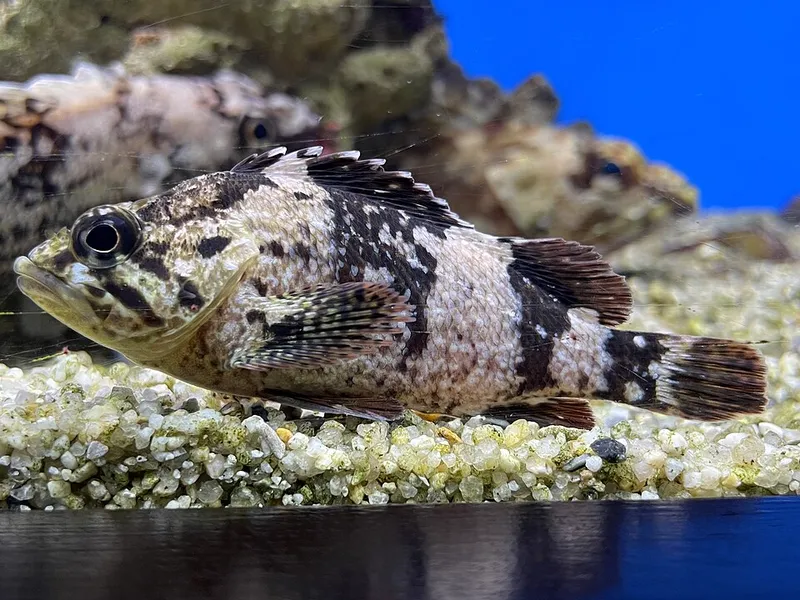
It stays put in the rocks and can be caught all year, though it comes into the shallows and feeds more readily from spring into early summer. The charm of it is that thirty centimetres of water over boulders is enough. It eats best in the cold months from autumn to spring.
About
Many carry venom in their fin spines. Their mottled coloring blends into rock and seaweed as they lie in wait for prey. Found in the southern Pacific coast of Japan, the Seto Inland Sea, and the northern Pacific coast of Japan.
Cut a strip of mackerel with the skin on, put it on a burakuri sinker and feed it deep into the tetrapods. Once it lands, lift the tip two or three times, give it twenty or thirty seconds, and if nothing happens move to the next hole rather than persisting.
On a boulder shore they hold in rock shade in water barely knee deep. Use a light jighead of about three grams, drop the soft plastic behind the rock at your feet and give it two or three lifts. Polarised glasses let you find the gaps between the rocks first.
Short hole-fishing rod, 1.2 mA short rod for dropping straight into gaps in the tetrapods. It is easy to handle and stiff enough to pull a fish out before it reaches its hole.¥2,000–6,000AdFind on AmazonFind on Rakuten
Spinning reel, size 1000-2000A small reel for chonage, hole fishing and light work. Light enough for a child to hold.¥2,500–8,000AdFind on AmazonFind on Rakuten
Nylon line, 3-gou (about 12 lb)For sabiki and hole fishing. Thick enough to resist abrasion on rock and to horse a rockfish straight up.¥600–2,000AdFind on AmazonFind on Rakuten
Burakuri (weighted single-hook jig), 3-8 gouA one-piece weight-and-hook rig for hole fishing. Drop it into a gap, tap the bottom, and draw the rockfish out.¥200–600AdFind on AmazonFind on Rakuten
Cut fish bait (saury, mackerel, sardine)For hole fishing, cutlassfish and larger rockfish. Salting the flesh firms it so it stays on the hook.¥300–900AdFind on AmazonFind on Rakuten
Fishing pliers / hook removerEssential protection from venomous spines and sharp teeth. Most injuries happen when someone unhooks a fish bare-handed.¥800–4,000AdFind on AmazonFind on Rakuten
Studded or felt-soled bootsOrdinary shoes slip on rock and tetrapods. Falls are the most common cause of accidents, so these are mandatory for rocky shores.¥4,000–15,000AdFind on AmazonFind on Rakuten
Life jacket, adult (Japan Craft Inspection approved)The first thing to buy, and worn on piers, rocks and boats alike. Boat fishing requires the government-approved type marked with the cherry-blossom stamp.¥5,000–20,000AdFind on AmazonFind on Rakuten
The cheapest tackle but the most dangerous footing. Do not skip the studded boots or the life jacket, and never step on wet tetrapods.
Product links may be affiliate links. Prices move, so treat the ranges as a guide.
There are sharp spines in the fins and on the gill covers. Other members of the same family do carry venomous spines and the two are easily confused, but no established source records venom in this species. The spines still go in deep and the wound can become infected, so handle it with gloves or a grip.
Simmered, deep-fried, or in miso soup. The head is large and the yield small, but the firm white flesh makes a strong stock, and little ones can go into the fryer whole.
Best eating: January–March, November, December
Rules
Check the local prefectural fishery regulation. It grows slowly and stays in the same hole, so taking the small ones repeatedly will empty a spot for good.