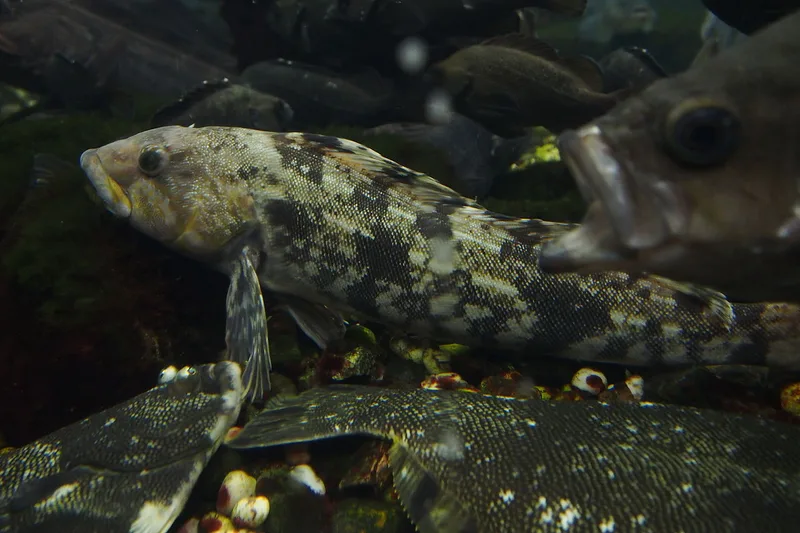
A northern rockfish that moves inshore to spawn in winter. In northern Japan it is a pier target; in the west it is scarce.
About
Unusual for having five lateral lines - one along the mid-flank and one at the base of each of the dorsal, pelvic and anal fins. Its scales are fine and its colour shifts from brown to reddish depending on where it lives. The similar Hexagrammos agrammus has only a single lateral line and a rounded tail, whereas this species has an angular one. Breeding males turn yellow and guard the egg mass.
Basics
Scientific name
Hexagrammos otakii
Family
Hexagrammidae (Greenlings)
Japanese name
アイナメ
Kana
あいなめ
Also called
アブラコ, アブラメ
Waters
Hokkaido & Sea of Okhotsk, Sea of Japan, Northern Pacific coast
Size
30 cm (max 60 cm)
Time of day
Dawn, Daytime, Dusk
Depth (tana)
On the bottom, along weed edges and rip-rap. In winter it comes into surprisingly shallow water.
Local names
アブラメ, アブラコ, アブラコ, アブラコ, ネウ
Ad slot
How to catch it
The standard approach is anaduri, dropping a burakuri rig (a compact painted sinker fused to a short hook) into holes among rocks, tetrapods and breakwaters. Surf casting and soft plastics work too, and it pulls hard for its size.
Anazuri (hole fishing in tetrapods) from a Breakwater / Pier
It ranges more widely than the scorpionfish, so a little patience in the same hole is worth it. In northern Japan it is the mainstay of the winter pier.
Waters: Hokkaido & Sea of Okhotsk, Sea of Japan, Northern Pacific coast
It holds on isolated rock and weed edges within otherwise sandy ground, and often comes up while you are surf fishing for flounder.
Waters: Hokkaido & Sea of Okhotsk, Sea of Japan, Northern Pacific coast
Kit for this fish
Hole fishing kit ・ Kit total ¥12,000–28,000
Short hole-fishing rod, 1.2 mA short rod for dropping straight into gaps in the tetrapods. It is easy to handle and stiff enough to pull a fish out before it reaches its hole.¥2,000–6,000AdFind on AmazonFind on Rakuten
Spinning reel, size 1000-2000A small reel for chonage, hole fishing and light work. Light enough for a child to hold.¥2,500–8,000AdFind on AmazonFind on Rakuten
Nylon line, 3-gou (about 12 lb)For sabiki and hole fishing. Thick enough to resist abrasion on rock and to horse a rockfish straight up.¥600–2,000AdFind on AmazonFind on Rakuten
Burakuri (weighted single-hook jig), 3-8 gouA one-piece weight-and-hook rig for hole fishing. Drop it into a gap, tap the bottom, and draw the rockfish out.¥200–600AdFind on AmazonFind on Rakuten
Cut fish bait (saury, mackerel, sardine)For hole fishing, cutlassfish and larger rockfish. Salting the flesh firms it so it stays on the hook.¥300–900AdFind on AmazonFind on Rakuten
Fishing pliers / hook removerEssential protection from venomous spines and sharp teeth. Most injuries happen when someone unhooks a fish bare-handed.¥800–4,000AdFind on AmazonFind on Rakuten
Studded or felt-soled bootsOrdinary shoes slip on rock and tetrapods. Falls are the most common cause of accidents, so these are mandatory for rocky shores.¥4,000–15,000AdFind on AmazonFind on Rakuten
Life jacket, adult (Japan Craft Inspection approved)The first thing to buy, and worn on piers, rocks and boats alike. Boat fishing requires the government-approved type marked with the cherry-blossom stamp.¥5,000–20,000AdFind on AmazonFind on Rakuten
The cheapest tackle but the most dangerous footing. Do not skip the studded boots or the life jacket, and never step on wet tetrapods.
Product links may be affiliate links. Prices move, so treat the ranges as a guide.