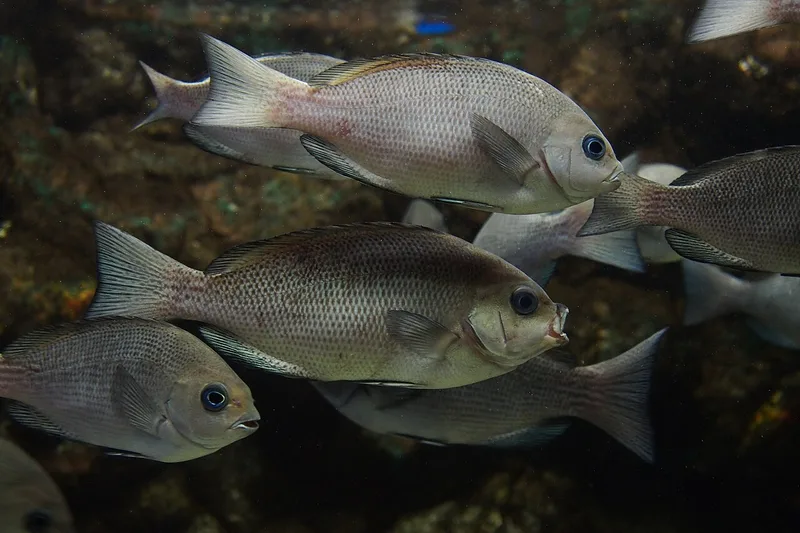
The season is winter, when it is called kan-mejina. In summer it smells strongly of the rocks and bait thieves swarm, so its value peaks in the cold.
About
A deep-bodied, blue-black fish with a dark spot at the base of each scale. The similar Girella leonina has a black-edged gill cover and a slimmer tail base. A favourite target of rock-shore anglers, it can exceed 60 cm. It takes crustaceans in summer and mostly seaweed in winter, when the shoreline tang fades and the flesh is at its best.
Basics
Scientific name
Girella punctata
Family
Girellidae (Nibblers)
Japanese name
メジナ
Kana
めじな
Also called
グレ, ぐれ, クロ
Waters
Southern Pacific coast, East China Sea & western Kyushu, Sea of Japan
Size
30 cm (max 50 cm)
Time of day
Dawn, Daytime
Depth (tana)
Surface to mid-water. It rises to the chum, so adjust the depth to how they respond that day.
Local names
グレ, グレ, グレ, クロ, クロ, クロ
Ad slot
How to catch it
The star of Japanese rock-shore fishing. Anglers lift the fish with krill chum and drift a light float rig on the current, a method called uki-fukase. Winter kan-gure, at their fattest, draw the biggest following.
Put the chum into the white water washing off the rocks and let the rig travel with it. On a winter rock mark the waves and the cold are the real danger: do not fish alone, and do not force a landing on a mark you are unsure of.
Waters: Sea of Japan, Southern Pacific coast, Seto Inland Sea, East China Sea & western Kyushu
Fukase (drift float) fishing from a Breakwater / Pier
A breakwater facing open water holds them, so you do not have to go to the rocks. It is the safer place to practise, and the right first step into fukase fishing.
Waters: Sea of Japan, Southern Pacific coast, Seto Inland Sea, East China Sea & western Kyushu
Kit for this fish
Fukase fishing kit ・ Kit total ¥45,000–120,000
Isozao #1.5, 5.3 mThe soft, long rod used for fukase fishing. Its through-action protects fine leaders while lifting big fish.¥12,000–45,000AdFind on AmazonFind on Rakuten
Spinning reel, size 2500The most versatile size for pier fishing: one reel covers sabiki, float fishing and eging.¥4,000–15,000AdFind on AmazonFind on Rakuten
Nylon line, 2-gou (about 8 lb)The standard for chonage and float fishing. Its stretch absorbs sudden runs and forgives an imperfect knot.¥600–2,000AdFind on AmazonFind on Rakuten
Fukase rig set (cone float, split shot, leader)A deliberately light rig that settles into the current. Moving a single split shot changes how it drifts.¥1,000–4,000AdFind on AmazonFind on Rakuten
Okiami krill (raw or boiled)The hook bait for float and fukase fishing. Boiled stands up to bait thieves; raw gets more bites.¥400–1,200AdFind on AmazonFind on Rakuten
Groundbait mix for chummingPowder mixed with krill so the chum throws well. Changing its density and stickiness delivers the chum to the depth you want.¥500–1,500AdFind on AmazonFind on Rakuten
Rope bucket for drawing seawaterUsed to rinse hands and chum and to keep fish alive. It is also how you leave the pier clean.¥800–2,500AdFind on AmazonFind on Rakuten
Landing net with 5 m handlePiers sit high above the water and heavy fish break off if you lift them. Having one changes what you land.¥4,000–20,000AdFind on AmazonFind on Rakuten
Cool box, 15-20 LFor carrying fish home cold. Take plenty of ice; in summer a poorly insulated box is not fit for the job.¥4,000–25,000AdFind on AmazonFind on Rakuten
Life jacket, adult (Japan Craft Inspection approved)The first thing to buy, and worn on piers, rocks and boats alike. Boat fishing requires the government-approved type marked with the cherry-blossom stamp.¥5,000–20,000AdFind on AmazonFind on Rakuten
Studded or felt-soled bootsOrdinary shoes slip on rock and tetrapods. Falls are the most common cause of accidents, so these are mandatory for rocky shores.¥4,000–15,000AdFind on AmazonFind on Rakuten
Built on the assumption that you will stand on rock. Of everything here, the studded boots and life jacket are the two items never to compromise on.
Product links may be affiliate links. Prices move, so treat the ranges as a guide.