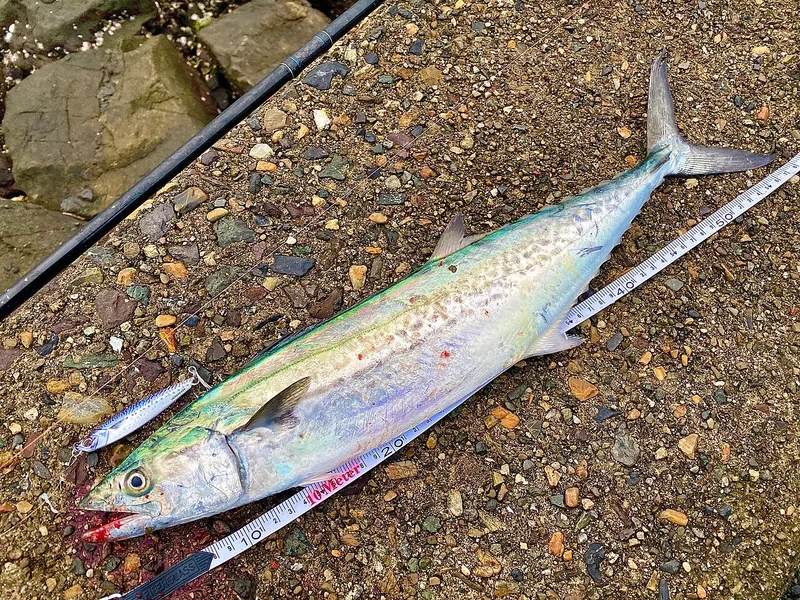
Small ones are called sagoshi and can be taken from piers on shore jigs. When you hit the autumn run, they come in a rush.
About
A slender, laterally compressed member of the mackerel family, marked with about seven rows of dark spots along each side; the back is blue-grey and the belly silvery white. Its Japanese name is said to come from sa-hara, "narrow belly". It grows past a metre and hunts anchovies and sand lance. Though thought of as a fish of spring, the fatty winter kan-zawara is equally prized.
Basics
Scientific name
Scomberomorus niphonius
Family
Scombridae (Mackerels, Tunas, and Bonitos)
Japanese name
サワラ
Kana
さわら
Also called
サゴシ, さごし, ヤナギ
Waters
Seto Inland Sea, Southern Pacific coast, Sea of Japan, East China Sea & western Kyushu
Size
60 cm (max 110 cm)
Time of day
Dawn, Dusk
Depth (tana)
Surface to mid-water. When a nabura appears, where baitfish boil at the surface under attack, cast around its edge.
Ad slot
How to catch it
Shore jigging from breakwaters and surf beaches is the accessible approach, with fish running from early summer into winter. Their teeth are razor-sharp, so a wire or heavy fluorocarbon leader is essential.
The best marks are the exposed points with the strongest flow, which are also the points that take the waves. On a day with swell in the forecast, the decision not to go comes first.
Waters: Sea of Japan, Southern Pacific coast, East China Sea & western Kyushu
Kit for this fish
Shore jigging kit ・ Kit total ¥40,000–100,000
Shore jigging rod, 10 ft, MHLong and powerful enough to cast 40-60 g jigs and to absorb the runs of a hooked jack.¥12,000–40,000AdFind on AmazonFind on Rakuten
Spinning reel, size 4000-5000For shore jigging. A smooth drag under a running fish matters more than anything here, so this is not the place to economise.¥10,000–35,000AdFind on AmazonFind on Rakuten
PE braid, 1.5-2 gouFor shore jigging: the compromise between casting distance and strength.¥2,000–6,000AdFind on AmazonFind on Rakuten
Fluorocarbon leaderThe clear line tied to the end of the braid. It resists abrasion and is less visible, protecting the braid from rock and teeth.¥800–3,000AdFind on AmazonFind on Rakuten
Metal jig, 30-60 gThe mainstay of shore jigging. Carry the same shape in several weights and switch with wind and current.¥600–2,500AdFind on AmazonFind on Rakuten
Landing net with 5 m handlePiers sit high above the water and heavy fish break off if you lift them. Having one changes what you land.¥4,000–20,000AdFind on AmazonFind on Rakuten
Fishing pliers / hook removerEssential protection from venomous spines and sharp teeth. Most injuries happen when someone unhooks a fish bare-handed.¥800–4,000AdFind on AmazonFind on Rakuten
Knife and spike for bleeding fishWhat turns a caught fish into good food; bleeding it changes the taste. See the column "Killing and carrying your catch" for how to use them.¥1,000–6,000AdFind on AmazonFind on Rakuten
Cool box, 15-20 LFor carrying fish home cold. Take plenty of ice; in summer a poorly insulated box is not fit for the job.¥4,000–25,000AdFind on AmazonFind on Rakuten
Life jacket, adult (Japan Craft Inspection approved)The first thing to buy, and worn on piers, rocks and boats alike. Boat fishing requires the government-approved type marked with the cherry-blossom stamp.¥5,000–20,000AdFind on AmazonFind on Rakuten
Studded or felt-soled bootsOrdinary shoes slip on rock and tetrapods. Falls are the most common cause of accidents, so these are mandatory for rocky shores.¥4,000–15,000AdFind on AmazonFind on Rakuten
You will often be on rocks or the tip of a breakwater at dawn, where safety gear matters more than results. Do not go alone.
Product links may be affiliate links. Prices move, so treat the ranges as a guide.
Its teeth are extremely sharp and cut both line and leader with ease. Cutting a finger while removing a lure is a common accident: always use pliers and pin the fish before you start.