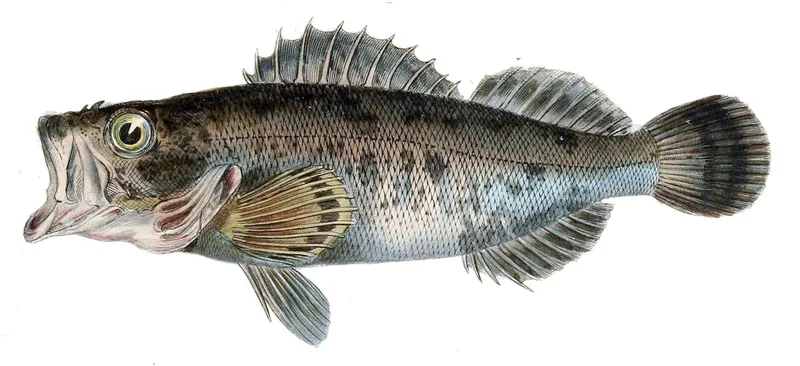
Known as the harbinger of spring, it fishes best on cold nights. It is what keeps winter pier fishing worth doing when everything else has gone.
About
Named for its large eyes, it is deeper-bodied and thinner from side to side than the false kelpfish. The body is blackish brown with a few faint dark bars. In 2008 it was split into three species - red, white and black - separated by pectoral fin ray counts of 15, 17 and 16 respectively. Like the false kelpfish it bears live young, and it is welcomed as a herald of spring.
Surface to mid-water around harbour lights. It hangs facing up into the current, so search from the top down.
Ad slot
How to catch it
Nocturnal, it moves into shallow weed beds and rocks after dark. Easy to target from breakwaters with a float rig or with soft-plastic lures, a style known as mebaring. Calm nights fish best.
Drift the rig along the line between light and shadow under a harbour lamp. Shining your headlamp onto the water pushes the fish down, so light only your feet. On winter nights, warm clothing and not fishing alone come before the fishing itself.
Waters: Sea of Japan, Northern Pacific coast, Southern Pacific coast, Seto Inland Sea, East China Sea & western Kyushu
Anazuri (hole fishing in tetrapods) from a Breakwater / Pier
It tends to hold above the level of the scorpionfish, so stop the rig short of the bottom and work it there. Three attempts with no response and you move to the next hole.
Waters: Sea of Japan, Northern Pacific coast, Southern Pacific coast, Seto Inland Sea, East China Sea & western Kyushu
Kit for this fish
Float fishing starter kit ・ Kit total ¥13,000–30,000
Isozao (telescopic shore rod) #3, 3.6 mThe standard rod for sabiki and float fishing. Telescopic, so it packs short and handles easily on a pier. If you buy one rod, buy this.¥4,000–9,000AdFind on AmazonFind on Rakuten
Spinning reel, size 2500The most versatile size for pier fishing: one reel covers sabiki, float fishing and eging.¥4,000–15,000AdFind on AmazonFind on Rakuten
Nylon line, 2-gou (about 8 lb)The standard for chonage and float fishing. Its stretch absorbs sudden runs and forgives an imperfect knot.¥600–2,000AdFind on AmazonFind on Rakuten
Float rig set (stick float / cone float)A pack with float, stopper, split shot and hook. It is all you need to start practising depth changes.¥500–1,500AdFind on AmazonFind on Rakuten
Okiami krill (raw or boiled)The hook bait for float and fukase fishing. Boiled stands up to bait thieves; raw gets more bites.¥400–1,200AdFind on AmazonFind on Rakuten
Rope bucket for drawing seawaterUsed to rinse hands and chum and to keep fish alive. It is also how you leave the pier clean.¥800–2,500AdFind on AmazonFind on Rakuten
Fishing pliers / hook removerEssential protection from venomous spines and sharp teeth. Most injuries happen when someone unhooks a fish bare-handed.¥800–4,000AdFind on AmazonFind on Rakuten
Cool box, 15-20 LFor carrying fish home cold. Take plenty of ice; in summer a poorly insulated box is not fit for the job.¥4,000–25,000AdFind on AmazonFind on Rakuten
Life jacket, adult (Japan Craft Inspection approved)The first thing to buy, and worn on piers, rocks and boats alike. Boat fishing requires the government-approved type marked with the cherry-blossom stamp.¥5,000–20,000AdFind on AmazonFind on Rakuten
Shares the rod and reel with the sabiki kit. The whole craft is in moving the stopper to find the depth.
Product links may be affiliate links. Prices move, so treat the ranges as a guide.
The dorsal spines and gill covers are hard and sharp. There is no strong venom, but a puncture from gripping the fish can become infected. Handle it with a fish grip.