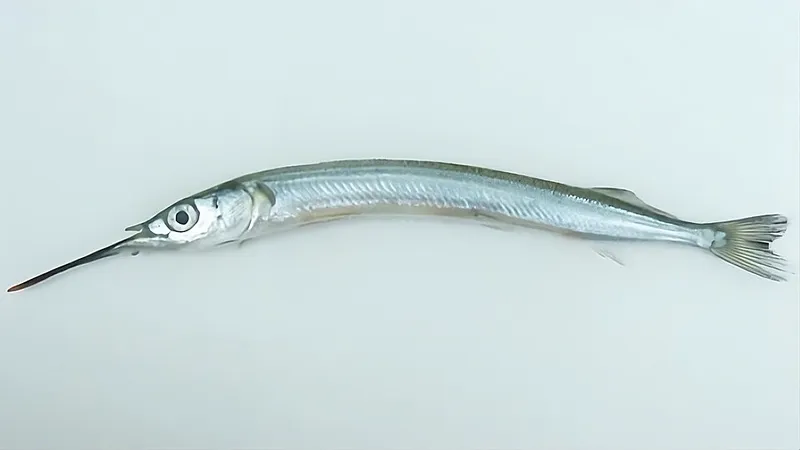
Schools come to the breakwaters in autumn, by which time the spring-hatched fish have grown into the twenties. Sizes improve through winter, and anything approaching 40 cm earns the name kannuki.
About
Only the lower jaw extends into a long needle, red at the tip in a living fish. The back is blue-green, the belly silver, and the flesh translucent. Its peritoneum is jet black, which in Japanese makes it a byword for someone who looks refined but is dark inside. It reaches about 40 cm; the smaller Kurume halfbeak is told apart by its black-tipped lower jaw.
Basics
Scientific name
Hyporhamphus sajori
Family
Hemiramphidae (Halfbeaks)
Japanese name
サヨリ
Kana
さより
Also called
カンヌキ, エンピツ, ヨド
Waters
Sea of Japan, Southern Pacific coast, Seto Inland Sea
Size
25 cm (max 40 cm)
Time of day
Dawn, Daytime
Depth (tana)
Right at the surface, with only 20 to 40 cm of line below the float. Fishing deeper only costs you bites, so when in doubt, shorten it.
Ad slot
How to catch it
Float fishing from breakwaters is the standard, from autumn through spring. Chum with amiebi shrimp and work a string of small shimori floats with the bait only 20 to 40 cm down, right at the surface.
Use a string of small floats with a chum cage, set so the whole line of beads rides on the surface as it drifts. Chum first to hold the school in front of you, keep the bait 20 to 40 cm down, and strike when a single bead pulls under.
Waters: Sea of Japan, Southern Pacific coast, Seto Inland Sea
Kit for this fish
Float fishing starter kit ・ Kit total ¥13,000–30,000
Isozao (telescopic shore rod) #3, 3.6 mThe standard rod for sabiki and float fishing. Telescopic, so it packs short and handles easily on a pier. If you buy one rod, buy this.¥4,000–9,000AdFind on AmazonFind on Rakuten
Spinning reel, size 2500The most versatile size for pier fishing: one reel covers sabiki, float fishing and eging.¥4,000–15,000AdFind on AmazonFind on Rakuten
Nylon line, 2-gou (about 8 lb)The standard for chonage and float fishing. Its stretch absorbs sudden runs and forgives an imperfect knot.¥600–2,000AdFind on AmazonFind on Rakuten
Float rig set (stick float / cone float)A pack with float, stopper, split shot and hook. It is all you need to start practising depth changes.¥500–1,500AdFind on AmazonFind on Rakuten
Okiami krill (raw or boiled)The hook bait for float and fukase fishing. Boiled stands up to bait thieves; raw gets more bites.¥400–1,200AdFind on AmazonFind on Rakuten
Rope bucket for drawing seawaterUsed to rinse hands and chum and to keep fish alive. It is also how you leave the pier clean.¥800–2,500AdFind on AmazonFind on Rakuten
Fishing pliers / hook removerEssential protection from venomous spines and sharp teeth. Most injuries happen when someone unhooks a fish bare-handed.¥800–4,000AdFind on AmazonFind on Rakuten
Cool box, 15-20 LFor carrying fish home cold. Take plenty of ice; in summer a poorly insulated box is not fit for the job.¥4,000–25,000AdFind on AmazonFind on Rakuten
Life jacket, adult (Japan Craft Inspection approved)The first thing to buy, and worn on piers, rocks and boats alike. Boat fishing requires the government-approved type marked with the cherry-blossom stamp.¥5,000–20,000AdFind on AmazonFind on Rakuten
Shares the rod and reel with the sabiki kit. The whole craft is in moving the stopper to find the depth.
Product links may be affiliate links. Prices move, so treat the ranges as a guide.
Delicate as sashimi or sushi, and good in tempura. The black membrane lining the belly carries the off-taste, so scrape it out with a finger and rinse well once the fish is opened.
Best eating: January, February, November, December