River mouths, harbours, beaches: it is everywhere, and big fish can be caught in the middle of a city. It is available all year but easiest around spawning and when baitfish are thick.
About
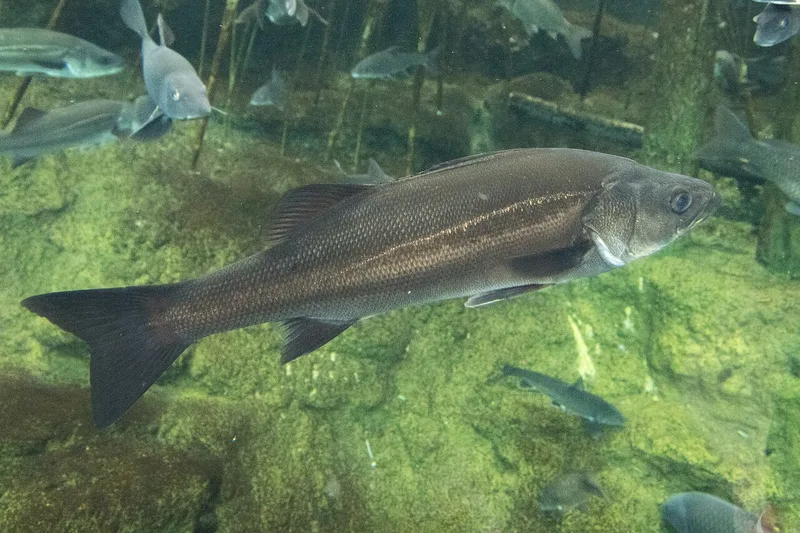
A slim, silvery fish that runs into river mouths and brackish water, and is renamed as it grows. Its mouth is large with the lower jaw projecting past the upper, and young fish carry small dark spots on the back and dorsal fin that disappear with age. Compared with the blackfin seabass, which is deeper-bodied with a thick tail base, this species is slimmer and its tail fin is more deeply forked. It is at its best in summer, served as arai, slices chilled in ice water, and lure anglers know it as seabass.
Basics
Scientific name
Lateolabrax japonicus
Family
スズキ科
Japanese name
スズキ
Kana
すずき
Also called
シーバス, しーばす, セイゴ, フッコ, ハネ
Waters
Sea of Japan, Northern Pacific coast, Southern Pacific coast, Seto Inland Sea, East China Sea & western Kyushu
Size
60 cm (max 100 cm)
Time of day
Dusk, Night, Dawn
Depth (tana)
Surface to mid-water. It holds on tide lines, the edge between light and shadow, and seams in the current, so look for boundaries in the flow rather than structure.
Local names
セイゴ→フッコ→スズキ, セイゴ→ハネ→スズキ, セイゴ→ハネ→スズキ
Ad slot
How to catch it
Under the name seabass it is one of Japan's most popular lure targets. The standard game is working minnows and vibration plugs at night around river mouths, harbors and canals.
Drift an electric float along the current seam. It only fishes while the tide is moving; when it stops, so do the bites. Hooked fish throw the hook by shaking their heads at the surface, so drop the rod tip and keep its head down.
It sits underneath wherever the baitfish are scattering. The gill covers are razor-edged, so pin the fish with a grip once it is landed; deep cuts from grabbing one bare-handed are common.
Waters: Sea of Japan, Northern Pacific coast, Southern Pacific coast, Seto Inland Sea, East China Sea & western Kyushu
Kit for this fish
Float fishing starter kit ・ Kit total ¥13,000–30,000
Isozao (telescopic shore rod) #3, 3.6 mThe standard rod for sabiki and float fishing. Telescopic, so it packs short and handles easily on a pier. If you buy one rod, buy this.¥4,000–9,000AdFind on AmazonFind on Rakuten
Spinning reel, size 2500The most versatile size for pier fishing: one reel covers sabiki, float fishing and eging.¥4,000–15,000AdFind on AmazonFind on Rakuten
Nylon line, 2-gou (about 8 lb)The standard for chonage and float fishing. Its stretch absorbs sudden runs and forgives an imperfect knot.¥600–2,000AdFind on AmazonFind on Rakuten
Float rig set (stick float / cone float)A pack with float, stopper, split shot and hook. It is all you need to start practising depth changes.¥500–1,500AdFind on AmazonFind on Rakuten
Okiami krill (raw or boiled)The hook bait for float and fukase fishing. Boiled stands up to bait thieves; raw gets more bites.¥400–1,200AdFind on AmazonFind on Rakuten
Rope bucket for drawing seawaterUsed to rinse hands and chum and to keep fish alive. It is also how you leave the pier clean.¥800–2,500AdFind on AmazonFind on Rakuten
Fishing pliers / hook removerEssential protection from venomous spines and sharp teeth. Most injuries happen when someone unhooks a fish bare-handed.¥800–4,000AdFind on AmazonFind on Rakuten
Cool box, 15-20 LFor carrying fish home cold. Take plenty of ice; in summer a poorly insulated box is not fit for the job.¥4,000–25,000AdFind on AmazonFind on Rakuten
Life jacket, adult (Japan Craft Inspection approved)The first thing to buy, and worn on piers, rocks and boats alike. Boat fishing requires the government-approved type marked with the cherry-blossom stamp.¥5,000–20,000AdFind on AmazonFind on Rakuten
Shares the rod and reel with the sabiki kit. The whole craft is in moving the stopper to find the depth.
Product links may be affiliate links. Prices move, so treat the ranges as a guide.