Activity rises in rivers and estuaries from early summer into autumn, especially after rain.
About
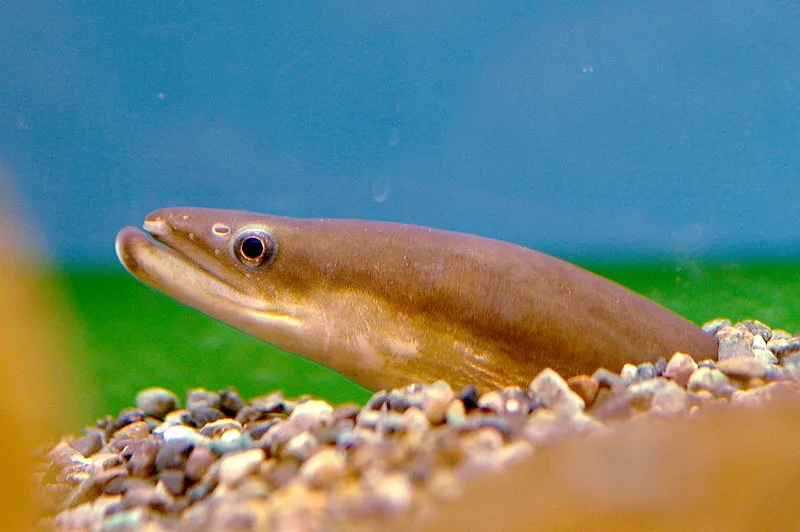
Its lower jaw juts out past the upper one, and it lacks the row of white spots that marks the conger — two quick ways to tell the two apart. The slimy skin conceals tiny scales embedded beneath it. After five to twelve years in fresh water it migrates to the sea west of the Mariana Islands to spawn, where wild eggs were finally collected in 2009.
On the bottom beside rocks where the current eases in rivers and estuaries.
Ad slot
How to catch it
Nocturnal, so it is fished on summer nights in the lower reaches of rivers and in estuaries with a simple bottom rig baited with earthworms. Work the foot of embankments and around snags. Some rivers impose size limits or closed seasons for conservation.
Chonage (short-cast bottom fishing) from a River mouth
After rain, place bait beside rocks where the current eases at dusk. Do not tear out a swallowed hook, and always check resource-management and local rules.
Compact all-round rod, 2.4 mThe entry rod for chonage and light bottom fishing. It packs down to about 50 cm, so it travels by train, and a child can swing it.¥2,500–6,000AdFind on AmazonFind on Rakuten
Spinning reel, size 1000-2000A small reel for chonage, hole fishing and light work. Light enough for a child to hold.¥2,500–8,000AdFind on AmazonFind on Rakuten
Nylon line, 2-gou (about 8 lb)The standard for chonage and float fishing. Its stretch absorbs sudden runs and forgives an imperfect knot.¥600–2,000AdFind on AmazonFind on Rakuten
Chonage rig set (sinker arm + 2 hooks)A pack with the sinker arm, weight and hooks together; you only have to tie one knot to the main line.¥300–900AdFind on AmazonFind on Rakuten
Jarime (small sandworm)Thinner than aoisome and better matched to the small mouths of whiting and goby.¥500–1,200AdFind on AmazonFind on Rakuten
Rope bucket for drawing seawaterUsed to rinse hands and chum and to keep fish alive. It is also how you leave the pier clean.¥800–2,500AdFind on AmazonFind on Rakuten
Fishing pliers / hook removerEssential protection from venomous spines and sharp teeth. Most injuries happen when someone unhooks a fish bare-handed.¥800–4,000AdFind on AmazonFind on Rakuten
Cool box, 15-20 LFor carrying fish home cold. Take plenty of ice; in summer a poorly insulated box is not fit for the job.¥4,000–25,000AdFind on AmazonFind on Rakuten
Life jacket, adult (Japan Craft Inspection approved)The first thing to buy, and worn on piers, rocks and boats alike. Boat fishing requires the government-approved type marked with the cherry-blossom stamp.¥5,000–20,000AdFind on AmazonFind on Rakuten
A compact rod travels by train. Jarime is the easiest bait to handle.
Product links may be affiliate links. Prices move, so treat the ranges as a guide.
Japan's Ministry of Health states that eel serum contains a protein toxin that can inflame eyes, the mouth, or wounds. Do not eat eel raw or let fresh blood contact mucosa or cuts; normal thorough cooking inactivates the toxin.