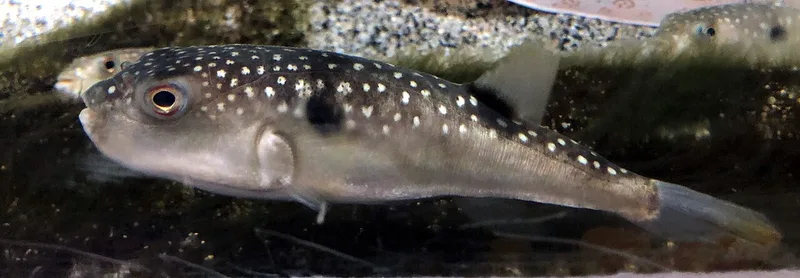
Extremely common along inner-bay piers, where it steals bait from every kind of rig. A large share of bitten-off rigs are its work.
About
Dark greenish-brown above, peppered with small round white spots, and marked by a clear black blotch just behind the pectoral fin, which separates it from the similar komon puffer (that species also has white spots below the eye). Usually 10-15 cm. On spring-tide nights in early summer, huge shoals crowd onto gravel beaches to spawn. Its organs and skin, above all the liver, gut and ovaries, are strongly poisonous.
Mid-water to bottom, often massed along the wall right at your feet.
Ad slot
How to catch it
Nobody fishes for it; it simply takes the bait off sabiki, float and bottom rigs alike. If your rig keeps getting bitten off, or the bait vanishes without a bite, assume they have swarmed the spot and change place or depth. The standard practice is to return it to the water on the spot rather than take it home.
Chonage (short-cast bottom fishing) from a Breakwater / Pier
If your bait keeps disappearing and your rigs keep getting bitten through, this is why. It cannot be eaten, since preparing pufferfish requires a licensed handler, so return it to the water on the spot and do not pass it on to anyone.
Waters: Sea of Japan, Northern Pacific coast, Southern Pacific coast, Seto Inland Sea, East China Sea & western Kyushu
Kit for this fish
Chonage starter kit ・ Kit total ¥11,000–24,000
Compact all-round rod, 2.4 mThe entry rod for chonage and light bottom fishing. It packs down to about 50 cm, so it travels by train, and a child can swing it.¥2,500–6,000AdFind on AmazonFind on Rakuten
Spinning reel, size 1000-2000A small reel for chonage, hole fishing and light work. Light enough for a child to hold.¥2,500–8,000AdFind on AmazonFind on Rakuten
Nylon line, 2-gou (about 8 lb)The standard for chonage and float fishing. Its stretch absorbs sudden runs and forgives an imperfect knot.¥600–2,000AdFind on AmazonFind on Rakuten
Chonage rig set (sinker arm + 2 hooks)A pack with the sinker arm, weight and hooks together; you only have to tie one knot to the main line.¥300–900AdFind on AmazonFind on Rakuten
Jarime (small sandworm)Thinner than aoisome and better matched to the small mouths of whiting and goby.¥500–1,200AdFind on AmazonFind on Rakuten
Rope bucket for drawing seawaterUsed to rinse hands and chum and to keep fish alive. It is also how you leave the pier clean.¥800–2,500AdFind on AmazonFind on Rakuten
Fishing pliers / hook removerEssential protection from venomous spines and sharp teeth. Most injuries happen when someone unhooks a fish bare-handed.¥800–4,000AdFind on AmazonFind on Rakuten
Cool box, 15-20 LFor carrying fish home cold. Take plenty of ice; in summer a poorly insulated box is not fit for the job.¥4,000–25,000AdFind on AmazonFind on Rakuten
Life jacket, adult (Japan Craft Inspection approved)The first thing to buy, and worn on piers, rocks and boats alike. Boat fishing requires the government-approved type marked with the cherry-blossom stamp.¥5,000–20,000AdFind on AmazonFind on Rakuten
A compact rod travels by train. Jarime is the easiest bait to handle.
Product links may be affiliate links. Prices move, so treat the ranges as a guide.
Some parts contain tetrodotoxin, which cooking does not make safe. Japan’s Ministry of Health warns anglers never to prepare self-caught pufferfish without professional controls. Do not eat it; this guide provides no preparation instructions.
This fish has toxic parts, so no preparation advice is given. Pufferfish handling requirements vary by prefecture. Follow Ministry of Health guidance and never prepare a self-caught pufferfish as an amateur.
Rules
Requirements for pufferfish handlers and facilities are set by prefectural rules. Follow Ministry of Health guidance: do not prepare a self-caught pufferfish as an amateur or give it to someone as food. Ask the local public health centre for current requirements.