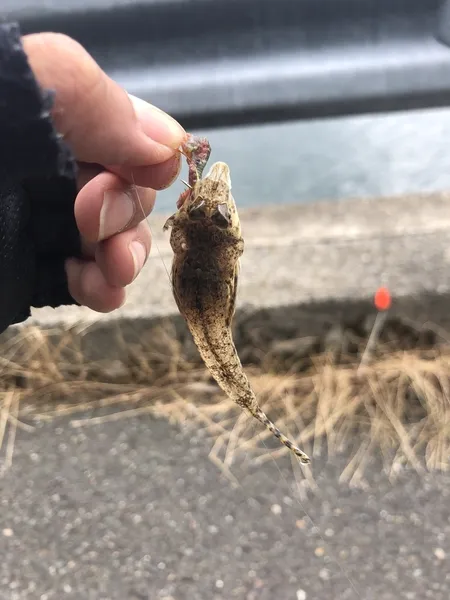
It comes shallow to spawn in spring and again in autumn while the water holds its warmth. It can be caught almost all year, but most anglers meet it as a by-catch while casting short for whiting. It eats best from winter into spring, when it fattens before spawning.
About
Flat-bodied fish without scales. The male has an oversized dorsal fin that he spreads to display to females. Found in the East China Sea and off western Kyushu and the Sea of Japan.
Basics
Scientific name
Callionymus curvicornis
Family
Callionymidae (Dragonets)
Japanese name
ネズミゴチ
Kana
ねずみごち
Also called
メゴチ, ガッチョ, テンコチ
Waters
East China Sea & western Kyushu, Sea of Japan
Size
15 cm (max 25 cm)
Time of day
Dawn, Daytime
Depth (tana)
On the bottom, where it half-buries itself with only the eyes showing, so keep the rig down and drag it so that it raises a little sand.
Ad slot
How to catch it
Chonage (short-cast bottom fishing) from a Breakwater / Pier
Drag more slowly than you would for whiting and never let the sinker leave the bottom. The bite is nothing more than a dull increase in weight. When you lift it in, do not take it by hand: hold it through a towel and keep clear of the gill cover.
Work carefully from the wash out to about five metres of water. Even on days when the whiting come up to feed, this fish stays pinned to the bottom. It usually takes while the rig is stationary, so pause before you wind in.
Waters: Sea of Japan, Southern Pacific coast, Seto Inland Sea, East China Sea & western Kyushu
Kit for this fish
Chonage starter kit ・ Kit total ¥11,000–24,000
Compact all-round rod, 2.4 mThe entry rod for chonage and light bottom fishing. It packs down to about 50 cm, so it travels by train, and a child can swing it.¥2,500–6,000AdFind on AmazonFind on Rakuten
Spinning reel, size 1000-2000A small reel for chonage, hole fishing and light work. Light enough for a child to hold.¥2,500–8,000AdFind on AmazonFind on Rakuten
Nylon line, 2-gou (about 8 lb)The standard for chonage and float fishing. Its stretch absorbs sudden runs and forgives an imperfect knot.¥600–2,000AdFind on AmazonFind on Rakuten
Chonage rig set (sinker arm + 2 hooks)A pack with the sinker arm, weight and hooks together; you only have to tie one knot to the main line.¥300–900AdFind on AmazonFind on Rakuten
Jarime (small sandworm)Thinner than aoisome and better matched to the small mouths of whiting and goby.¥500–1,200AdFind on AmazonFind on Rakuten
Rope bucket for drawing seawaterUsed to rinse hands and chum and to keep fish alive. It is also how you leave the pier clean.¥800–2,500AdFind on AmazonFind on Rakuten
Fishing pliers / hook removerEssential protection from venomous spines and sharp teeth. Most injuries happen when someone unhooks a fish bare-handed.¥800–4,000AdFind on AmazonFind on Rakuten
Cool box, 15-20 LFor carrying fish home cold. Take plenty of ice; in summer a poorly insulated box is not fit for the job.¥4,000–25,000AdFind on AmazonFind on Rakuten
Life jacket, adult (Japan Craft Inspection approved)The first thing to buy, and worn on piers, rocks and boats alike. Boat fishing requires the government-approved type marked with the cherry-blossom stamp.¥5,000–20,000AdFind on AmazonFind on Rakuten
A compact rod travels by train. Jarime is the easiest bait to handle.
Product links may be affiliate links. Prices move, so treat the ranges as a guide.
A strong, serrated spine sits on the front of the gill cover and will go into a bare hand. No venom is recorded, but the body is coated in heavy slime, and most injuries happen when a hand slips and has to re-grip. Hold it through a towel or newspaper and unhook it with pliers.