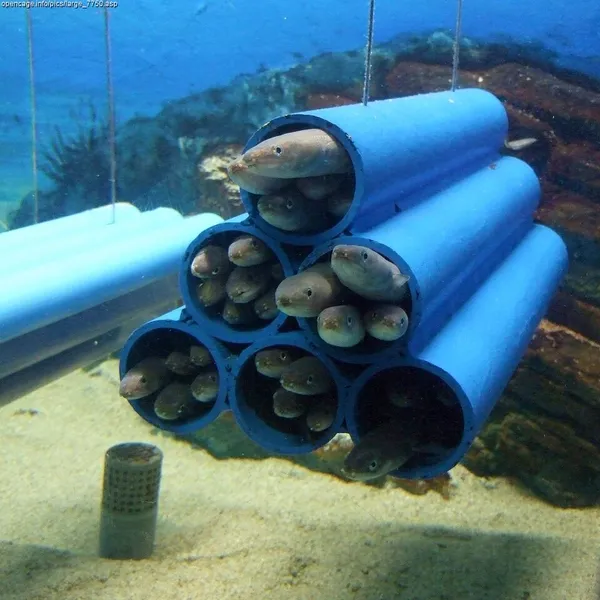
It comes out of the mud as the sun goes down. The season in sheltered harbours runs from early summer into autumn, and the fish drop into deeper water as the sea cools. The fishing is concentrated in the two hours after sunset.
About
A scatter of white dots runs along and above the lateral line, resembling the marks on a ruler — hence the nickname hakarime, "measuring eye." Unlike the freshwater eel, its upper jaw projects beyond the lower, and its eyes are large. It hides in burrows in sandy mud by day and hunts small fish and crustaceans at night. A staple of Tokyo-style tempura and sushi.
Basics
Scientific name
Conger myriaster
Family
Congridae (Congers and Garden Eels)
Japanese name
マアナゴ
Kana
まあなご
Also called
アナゴ, ハカリメ
Waters
Northern Pacific coast, Southern Pacific coast, Seto Inland Sea, East China Sea & western Kyushu
Size
40 cm (max 90 cm)
Time of day
Dusk, Night
Depth (tana)
On the bottom. Lay the rig on the sand and leave it there, letting the scent do the work, along the line where rip-rap meets sand or at the edge of the light from a harbour lamp.
Ad slot
How to catch it
Strictly nocturnal. In Tokyo Bay the night conger boats from mid-April to July are a seasonal fixture, tapping a sinker on the bottom under the hull or casting short. It is also caught after dark from breakwaters.
Chonage (short-cast bottom fishing) from a Breakwater / Pier
Arrive half an hour before sunset and tie everything while you can still see. Use one fat sea worm on the hook, cast, tighten the line and rest the rod. When the tip light starts twitching, count three before you strike.
Set two rods and fan the casts. A plain running sinker of ten to fifteen go is enough, baited with a bunch of worms or a strip of saury. Leave a little slack rather than winding up tight, and do not move the rig while the scent does its work.
Waters: Northern Pacific coast, Southern Pacific coast, Seto Inland Sea, East China Sea & western Kyushu
Kit for this fish
Chonage starter kit ・ Kit total ¥11,000–24,000
Compact all-round rod, 2.4 mThe entry rod for chonage and light bottom fishing. It packs down to about 50 cm, so it travels by train, and a child can swing it.¥2,500–6,000AdFind on AmazonFind on Rakuten
Spinning reel, size 1000-2000A small reel for chonage, hole fishing and light work. Light enough for a child to hold.¥2,500–8,000AdFind on AmazonFind on Rakuten
Nylon line, 2-gou (about 8 lb)The standard for chonage and float fishing. Its stretch absorbs sudden runs and forgives an imperfect knot.¥600–2,000AdFind on AmazonFind on Rakuten
Chonage rig set (sinker arm + 2 hooks)A pack with the sinker arm, weight and hooks together; you only have to tie one knot to the main line.¥300–900AdFind on AmazonFind on Rakuten
Jarime (small sandworm)Thinner than aoisome and better matched to the small mouths of whiting and goby.¥500–1,200AdFind on AmazonFind on Rakuten
Rope bucket for drawing seawaterUsed to rinse hands and chum and to keep fish alive. It is also how you leave the pier clean.¥800–2,500AdFind on AmazonFind on Rakuten
Fishing pliers / hook removerEssential protection from venomous spines and sharp teeth. Most injuries happen when someone unhooks a fish bare-handed.¥800–4,000AdFind on AmazonFind on Rakuten
Cool box, 15-20 LFor carrying fish home cold. Take plenty of ice; in summer a poorly insulated box is not fit for the job.¥4,000–25,000AdFind on AmazonFind on Rakuten
Life jacket, adult (Japan Craft Inspection approved)The first thing to buy, and worn on piers, rocks and boats alike. Boat fishing requires the government-approved type marked with the cherry-blossom stamp.¥5,000–20,000AdFind on AmazonFind on Rakuten
A compact rod travels by train. Jarime is the easiest bait to handle.
Product links may be affiliate links. Prices move, so treat the ranges as a guide.
Its jaws are lined with fine teeth and the body writhes constantly, so a bare hand cannot hold it. The slime makes it slip: pin it with a wet towel or a fish grip and unhook it with pliers.
Tempura, simmered, or grilled plain. The blood carries a toxin that heat destroys, so it is not eaten raw; wash your hands, your tools and any splashes near your eyes after cleaning one.
Best eating: June–August
Rules
Many harbours are closed to entry or parking after dark. On top of the prefectural rules, always read the harbour operator's signage.