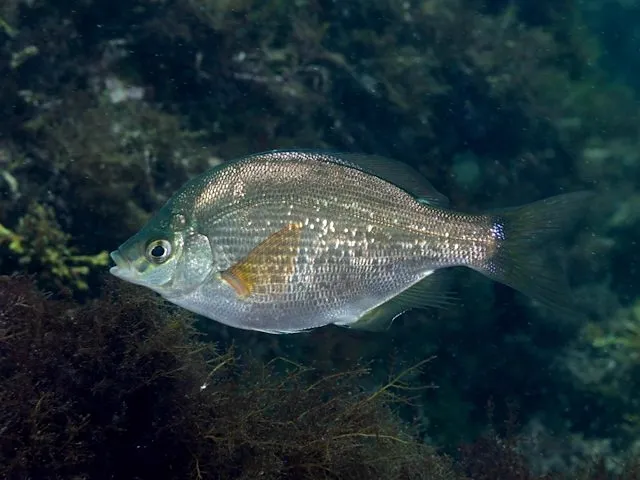
One of the few fish a breakwater offers in the empty months of winter. From March to May they move into the shallows to give birth and come to hand with swollen bellies; handle them gently then, and keep the numbers you take down.
About
Unusually among marine fish, they give birth to live young rather than laying eggs. The newborns already look like miniature adults. Found in the southern Pacific coast of Japan, the waters off Hokkaido and the Sea of Okhotsk, and the northern Pacific coast of Japan.
Mid-water: not the bottom and not the top, but suspended a little way off the wall. Matching the height of the gaps in the weed is what lifts the count.
Ad slot
How to catch it
Through winter and early spring it gives steady sport from a breakwater on a pole and a small float. Fish a little krill or a short piece of worm in mid-water, along weed edges or a metre off the harbour wall. The bite is slight: the float simply slides sideways.
Start with the bait about a fathom down and lengthen by 30 cm at a time if nothing comes. Keep the bait small: half a krill, with the hook buried in it. A steady trickle of chum holds the shoal against the wall.
It mixes into winter fukase fishing for nibblers, taking above the fish you actually want. If it keeps coming, throw the chum further out to draw the shoal off your hook bait. Its presence at least tells you the groundbait is working.
Float fishing starter kit ・ Kit total ¥13,000–30,000
Isozao (telescopic shore rod) #3, 3.6 mThe standard rod for sabiki and float fishing. Telescopic, so it packs short and handles easily on a pier. If you buy one rod, buy this.¥4,000–9,000AdFind on AmazonFind on Rakuten
Spinning reel, size 2500The most versatile size for pier fishing: one reel covers sabiki, float fishing and eging.¥4,000–15,000AdFind on AmazonFind on Rakuten
Nylon line, 2-gou (about 8 lb)The standard for chonage and float fishing. Its stretch absorbs sudden runs and forgives an imperfect knot.¥600–2,000AdFind on AmazonFind on Rakuten
Float rig set (stick float / cone float)A pack with float, stopper, split shot and hook. It is all you need to start practising depth changes.¥500–1,500AdFind on AmazonFind on Rakuten
Okiami krill (raw or boiled)The hook bait for float and fukase fishing. Boiled stands up to bait thieves; raw gets more bites.¥400–1,200AdFind on AmazonFind on Rakuten
Rope bucket for drawing seawaterUsed to rinse hands and chum and to keep fish alive. It is also how you leave the pier clean.¥800–2,500AdFind on AmazonFind on Rakuten
Fishing pliers / hook removerEssential protection from venomous spines and sharp teeth. Most injuries happen when someone unhooks a fish bare-handed.¥800–4,000AdFind on AmazonFind on Rakuten
Cool box, 15-20 LFor carrying fish home cold. Take plenty of ice; in summer a poorly insulated box is not fit for the job.¥4,000–25,000AdFind on AmazonFind on Rakuten
Life jacket, adult (Japan Craft Inspection approved)The first thing to buy, and worn on piers, rocks and boats alike. Boat fishing requires the government-approved type marked with the cherry-blossom stamp.¥5,000–20,000AdFind on AmazonFind on Rakuten
Shares the rod and reel with the sabiki kit. The whole craft is in moving the stopper to find the depth.
Product links may be affiliate links. Prices move, so treat the ranges as a guide.
Salt-grilled or simmered. The flesh is watery and bony, so eat it the day you catch it, or dry it overnight to firm it up. A winter fish carries fat and is another thing entirely.
Best eating: January, February, November, December
Rules
Check the local prefectural fishery regulation, and release small fish, particularly in spring when they are carrying young.