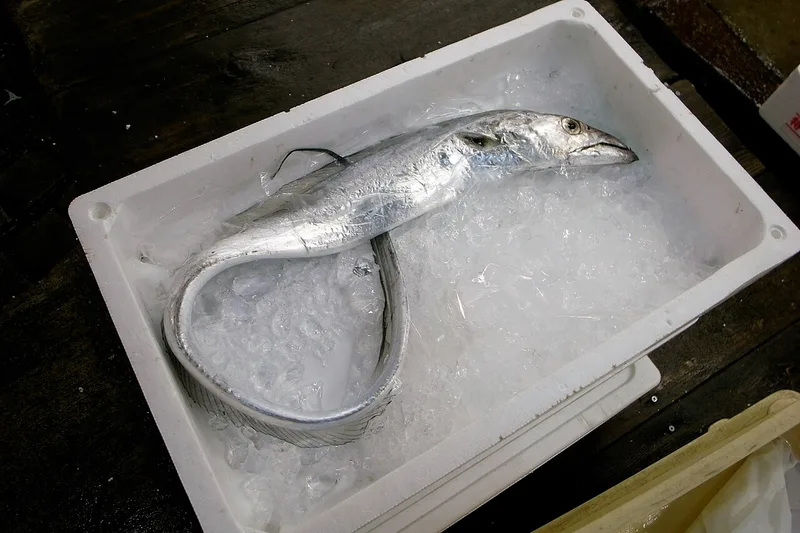
Comes to the piers at night from summer into early winter. It feeds hard in the hour right after sunset, making the window unusually clear.
About
Its body gleams like a drawn sword. There are no scales; the silver comes from a layer of guanine over the skin. The tail and pelvic fins are reduced, so it swims by rippling the long dorsal fin that runs the length of its back, and in slack water it hangs vertically with its head up. It reaches 1.5 m and seizes small fish with razor-like teeth.
Basics
Scientific name
Trichiurus japonicus
Family
タチウオ科
Japanese name
タチウオ
Kana
たちうお
Also called
タチ, たちうお
Waters
Southern Pacific coast, Seto Inland Sea, East China Sea & western Kyushu, Sea of Japan
Size
80 cm (max 150 cm)
Time of day
Dusk, Night
Depth (tana)
Mid-water to surface: shallow right after sunset, deeper as the night goes on. An electric float lets you manage the depth.
Ad slot
How to catch it
From summer to late autumn it is fished at night off deep harbour walls and bayside breakwaters, with float rigs, tenya jigs or darting wind-style lure work. The teeth are razor-sharp, so land it carefully.
The hour right after sunset is by far the best. Use an electric float to manage depth, starting shallow and working down. A wire trace is mandatory because of the teeth, and never leave a landed fish loose at your feet in the dark.
Worked with the darting side-to-side action known as wind. It needs no bait and lets you cast again immediately, so you waste none of the short window while a school is passing.
Waters: Sea of Japan, Southern Pacific coast, Seto Inland Sea, East China Sea & western Kyushu
Kit for this fish
Float fishing starter kit ・ Kit total ¥13,000–30,000
Isozao (telescopic shore rod) #3, 3.6 mThe standard rod for sabiki and float fishing. Telescopic, so it packs short and handles easily on a pier. If you buy one rod, buy this.¥4,000–9,000AdFind on AmazonFind on Rakuten
Spinning reel, size 2500The most versatile size for pier fishing: one reel covers sabiki, float fishing and eging.¥4,000–15,000AdFind on AmazonFind on Rakuten
Nylon line, 2-gou (about 8 lb)The standard for chonage and float fishing. Its stretch absorbs sudden runs and forgives an imperfect knot.¥600–2,000AdFind on AmazonFind on Rakuten
Float rig set (stick float / cone float)A pack with float, stopper, split shot and hook. It is all you need to start practising depth changes.¥500–1,500AdFind on AmazonFind on Rakuten
Okiami krill (raw or boiled)The hook bait for float and fukase fishing. Boiled stands up to bait thieves; raw gets more bites.¥400–1,200AdFind on AmazonFind on Rakuten
Rope bucket for drawing seawaterUsed to rinse hands and chum and to keep fish alive. It is also how you leave the pier clean.¥800–2,500AdFind on AmazonFind on Rakuten
Fishing pliers / hook removerEssential protection from venomous spines and sharp teeth. Most injuries happen when someone unhooks a fish bare-handed.¥800–4,000AdFind on AmazonFind on Rakuten
Cool box, 15-20 LFor carrying fish home cold. Take plenty of ice; in summer a poorly insulated box is not fit for the job.¥4,000–25,000AdFind on AmazonFind on Rakuten
Life jacket, adult (Japan Craft Inspection approved)The first thing to buy, and worn on piers, rocks and boats alike. Boat fishing requires the government-approved type marked with the cherry-blossom stamp.¥5,000–20,000AdFind on AmazonFind on Rakuten
Shares the rod and reel with the sabiki kit. The whole craft is in moving the stopper to find the depth.
Product links may be affiliate links. Prices move, so treat the ranges as a guide.
Rows of knife-like canines cut leader instantly. Grabbing one bare-handed causes deep lacerations, and a thrashing fish is itself dangerous. Always handle it with a fish grip and pliers, and never leave one loose at your feet in the dark.