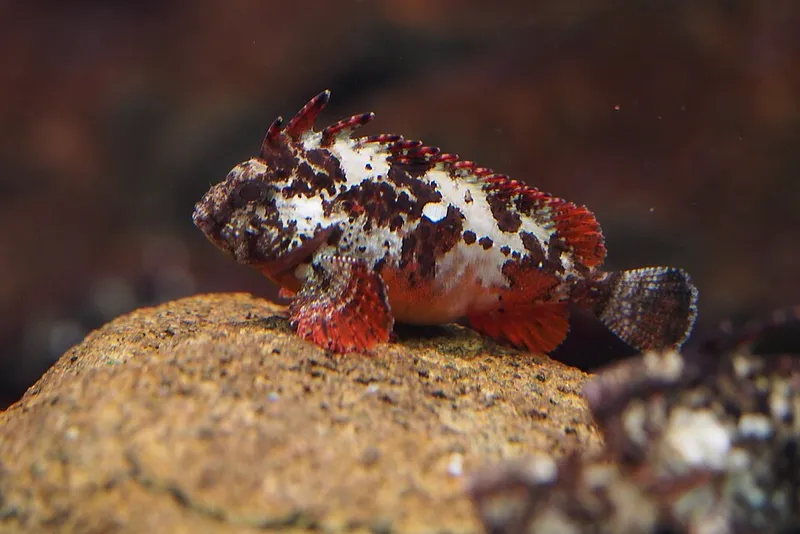
Extremely common along breakwaters from early summer into autumn. Nobody fishes for it; it simply turns up in the middle of a sabiki or float session. A child is quite likely to meet one on their first day of fishing, so learn to recognise it before you go.
About
They lie in wait disguised as rock or sand. The dorsal fin spines carry a powerful venom. Found in the southern Pacific coast of Japan and the Sea of Japan.
Basics
Scientific name
Paracentropogon rubripinnis
Family
Synanceiidae (Stonefishes)
Japanese name
ハオコゼ
Kana
はおこぜ
Also called
オコゼ
Waters
Southern Pacific coast, Sea of Japan
Size
8 cm (max 12 cm)
Time of day
Dawn, Daytime, Dusk
Depth (tana)
From the bottom into mid-water, tucked motionless among the stones and weed against the harbour wall. It usually comes up on the lowest hook of a sabiki rig.
Ad slot
How to catch it
Nobody fishes for it. It lies among weed and rip-rap along the pier and comes up on sabiki, float and bottom rigs alike. When you land one, do not deal with it in mid-air: put it on the ground first. Swinging it about on the line puts the spines within reach of you and of whoever is standing beside you.
Sabiki (bait-jig) fishing from a Breakwater / Pier
If a small reddish-brown fish comes up on the bottom hook of the sabiki, suspect this one first. Being small does not make it harmless. Keep children away from it: an adult should put the fish on the ground, pin it with a grip and unhook it with pliers.
Waters: Southern Pacific coast, Sea of Japan, Seto Inland Sea
It takes when the float sinks slowly close to the wall or over weed. If unhooking looks awkward, cutting the leader and returning the fish is the safer choice. The spines stay venomous after death, so never forget that one is in your bucket or cool box.
Waters: Southern Pacific coast, Sea of Japan, Seto Inland Sea
Kit for this fish
Sabiki starter kit ・ Kit total ¥14,000–32,000
Isozao (telescopic shore rod) #3, 3.6 mThe standard rod for sabiki and float fishing. Telescopic, so it packs short and handles easily on a pier. If you buy one rod, buy this.¥4,000–9,000AdFind on AmazonFind on Rakuten
Spinning reel, size 2500The most versatile size for pier fishing: one reel covers sabiki, float fishing and eging.¥4,000–15,000AdFind on AmazonFind on Rakuten
Nylon line, 3-gou (about 12 lb)For sabiki and hole fishing. Thick enough to resist abrasion on rock and to horse a rockfish straight up.¥600–2,000AdFind on AmazonFind on Rakuten
Sabiki rig (hook size 3-6)A ready-made string of feathered hooks. Match the hook size to the fish: 3 for small horse mackerel, 6 for better ones.¥200–600AdFind on AmazonFind on Rakuten
Krill cage with sinker (for sabiki)The cage you pack with krill to release chum. Bottom-cage versions are the easier choice from a pier.¥200–800AdFind on AmazonFind on Rakuten
Frozen krill, amiebi (block or tube)The chum for sabiki fishing. The tube type needs no thawing and keeps your hands clean, which suits families.¥300–1,200AdFind on AmazonFind on Rakuten
Rope bucket for drawing seawaterUsed to rinse hands and chum and to keep fish alive. It is also how you leave the pier clean.¥800–2,500AdFind on AmazonFind on Rakuten
Fishing pliers / hook removerEssential protection from venomous spines and sharp teeth. Most injuries happen when someone unhooks a fish bare-handed.¥800–4,000AdFind on AmazonFind on Rakuten
Cool box, 15-20 LFor carrying fish home cold. Take plenty of ice; in summer a poorly insulated box is not fit for the job.¥4,000–25,000AdFind on AmazonFind on Rakuten
Life jacket, adult (Japan Craft Inspection approved)The first thing to buy, and worn on piers, rocks and boats alike. Boat fishing requires the government-approved type marked with the cherry-blossom stamp.¥5,000–20,000AdFind on AmazonFind on Rakuten
Always include the life jacket, and add the child version if you are bringing children. This kit alone is enough to start.
Product links may be affiliate links. Prices move, so treat the ranges as a guide.
Its fin spines are regarded as venomous and a puncture may cause severe pain or swelling. Do not handle even a small specimen bare-handed; use a fish grip and pliers. If stung, clean the wound and seek medical advice.
Because handling the venomous spines is hazardous, this guide does not recommend treating it as food.
Rules
Check the local fishery regulation. Leaving a venomous fish on a pier injures other anglers and children, and is a direct cause of spots being closed to fishing.