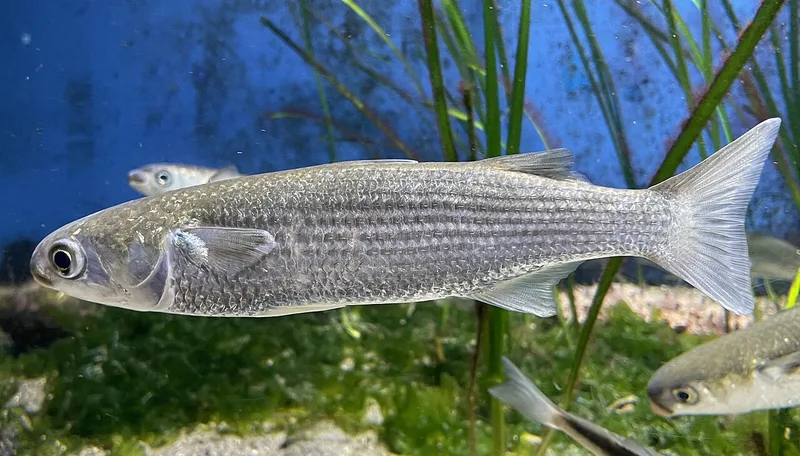
The fish you see leaping inside a harbour. Few people target it, but it hooks up in every kind of fishing, so it is identified constantly.
About
Blue-grey above and silvery below with faint stripes along the flanks, growing to nearly a metre. A clear fatty eyelid covers the eye, which the redlip mullet lacks. It favours estuaries and brackish water and leaps clear of the surface, sometimes two or three body lengths high. Japanese gives it a different name at each stage of growth, and its salted, dried roe becomes the delicacy karasumi.
Basics
Scientific name
Mugil cephalus
Family
Mugilidae (Mullets)
Japanese name
ボラ
Kana
ぼら
Waters
Northern Pacific coast, Southern Pacific coast, Seto Inland Sea, East China Sea & western Kyushu, Rivers & lakes
Size
40 cm (max 80 cm)
Time of day
Dawn, Daytime, Dusk
Depth (tana)
Surface to mid-water. It crowds into chum and hooks up on sabiki and float rigs.
Local names
オボコ→イナ→ボラ→トド
Ad slot
How to catch it
Fished with a float rig and krill bait in estuaries and harbours. Better known as an incidental catch on sabiki rigs and lures, and it fights hard. Winter is the time to go after it.
Sabiki (bait-jig) fishing from a Breakwater / Pier
The classic by-catch drawn in by chum. It is big enough to break a light rig, so net it rather than lifting it, or cut the leader and let it go on the spot.
Waters: Sea of Japan, Northern Pacific coast, Southern Pacific coast, Seto Inland Sea, East China Sea & western Kyushu
Kit for this fish
Sabiki starter kit ・ Kit total ¥14,000–32,000
Isozao (telescopic shore rod) #3, 3.6 mThe standard rod for sabiki and float fishing. Telescopic, so it packs short and handles easily on a pier. If you buy one rod, buy this.¥4,000–9,000AdFind on AmazonFind on Rakuten
Spinning reel, size 2500The most versatile size for pier fishing: one reel covers sabiki, float fishing and eging.¥4,000–15,000AdFind on AmazonFind on Rakuten
Nylon line, 3-gou (about 12 lb)For sabiki and hole fishing. Thick enough to resist abrasion on rock and to horse a rockfish straight up.¥600–2,000AdFind on AmazonFind on Rakuten
Sabiki rig (hook size 3-6)A ready-made string of feathered hooks. Match the hook size to the fish: 3 for small horse mackerel, 6 for better ones.¥200–600AdFind on AmazonFind on Rakuten
Krill cage with sinker (for sabiki)The cage you pack with krill to release chum. Bottom-cage versions are the easier choice from a pier.¥200–800AdFind on AmazonFind on Rakuten
Frozen krill, amiebi (block or tube)The chum for sabiki fishing. The tube type needs no thawing and keeps your hands clean, which suits families.¥300–1,200AdFind on AmazonFind on Rakuten
Rope bucket for drawing seawaterUsed to rinse hands and chum and to keep fish alive. It is also how you leave the pier clean.¥800–2,500AdFind on AmazonFind on Rakuten
Fishing pliers / hook removerEssential protection from venomous spines and sharp teeth. Most injuries happen when someone unhooks a fish bare-handed.¥800–4,000AdFind on AmazonFind on Rakuten
Cool box, 15-20 LFor carrying fish home cold. Take plenty of ice; in summer a poorly insulated box is not fit for the job.¥4,000–25,000AdFind on AmazonFind on Rakuten
Life jacket, adult (Japan Craft Inspection approved)The first thing to buy, and worn on piers, rocks and boats alike. Boat fishing requires the government-approved type marked with the cherry-blossom stamp.¥5,000–20,000AdFind on AmazonFind on Rakuten
Always include the life jacket, and add the child version if you are bringing children. This kit alone is enough to start.
Product links may be affiliate links. Prices move, so treat the ranges as a guide.
Winter fish from clean water make good sashimi, but harbour fish carry a strong off-taste and are usually avoided. The roe is the raw material for karasumi.
Best eating: January, February, November, December