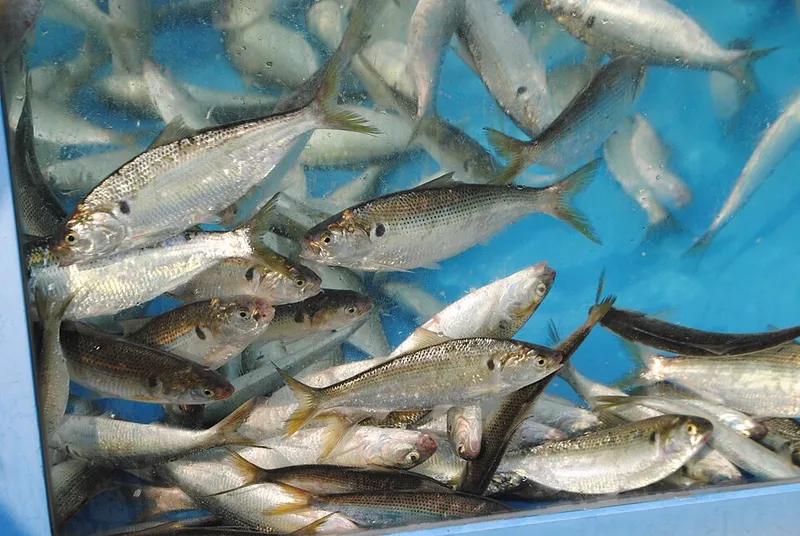
Schools push into sheltered harbours from autumn into early spring. They come in numbers and are full of small bones, so to many anglers their real value is as live bait for larger fish. Anything over 20 cm pulls hard in its own right.
About
The rear tip of its dorsal fin trails like a thread. The kohada of Edo-style sushi is the young of this species, which is renamed as it grows.
Basics
Scientific name
Konosirus punctatus
Family
ニシン科
Japanese name
コノシロ
Kana
このしろ
Also called
コハダ, シンコ, ナカズミ, ドロクイ
Waters
Southern Pacific coast, Seto Inland Sea, East China Sea & western Kyushu
Size
25 cm (max 32 cm)
Time of day
Dawn, Daytime, Dusk
Depth (tana)
Surface to mid-water. The school moves into the chum trail and crosses above the horse mackerel, unmistakable for its size.
Local names
シンコ→コハダ→ナカズミ→コノシロ
Ad slot
How to catch it
Schools come to sabiki rigs off breakwaters in autumn. Use minced-shrimp chum and a rig with larger hooks; a casting sabiki reaches schools holding farther out.
Sabiki (bait-jig) fishing from a Breakwater / Pier
Pick a sabiki with larger hooks than the horse mackerel rigs use. These fish top 20 cm and fight hard enough to tear their own mouths if you swing them up. Keep a few alive in a bucket and you have live bait for flounder or seabass on the spot.
Waters: Southern Pacific coast, Seto Inland Sea, East China Sea & western Kyushu
Kit for this fish
Sabiki starter kit ・ Kit total ¥14,000–32,000
Isozao (telescopic shore rod) #3, 3.6 mThe standard rod for sabiki and float fishing. Telescopic, so it packs short and handles easily on a pier. If you buy one rod, buy this.¥4,000–9,000AdFind on AmazonFind on Rakuten
Spinning reel, size 2500The most versatile size for pier fishing: one reel covers sabiki, float fishing and eging.¥4,000–15,000AdFind on AmazonFind on Rakuten
Nylon line, 3-gou (about 12 lb)For sabiki and hole fishing. Thick enough to resist abrasion on rock and to horse a rockfish straight up.¥600–2,000AdFind on AmazonFind on Rakuten
Sabiki rig (hook size 3-6)A ready-made string of feathered hooks. Match the hook size to the fish: 3 for small horse mackerel, 6 for better ones.¥200–600AdFind on AmazonFind on Rakuten
Krill cage with sinker (for sabiki)The cage you pack with krill to release chum. Bottom-cage versions are the easier choice from a pier.¥200–800AdFind on AmazonFind on Rakuten
Frozen krill, amiebi (block or tube)The chum for sabiki fishing. The tube type needs no thawing and keeps your hands clean, which suits families.¥300–1,200AdFind on AmazonFind on Rakuten
Rope bucket for drawing seawaterUsed to rinse hands and chum and to keep fish alive. It is also how you leave the pier clean.¥800–2,500AdFind on AmazonFind on Rakuten
Fishing pliers / hook removerEssential protection from venomous spines and sharp teeth. Most injuries happen when someone unhooks a fish bare-handed.¥800–4,000AdFind on AmazonFind on Rakuten
Cool box, 15-20 LFor carrying fish home cold. Take plenty of ice; in summer a poorly insulated box is not fit for the job.¥4,000–25,000AdFind on AmazonFind on Rakuten
Life jacket, adult (Japan Craft Inspection approved)The first thing to buy, and worn on piers, rocks and boats alike. Boat fishing requires the government-approved type marked with the cherry-blossom stamp.¥5,000–20,000AdFind on AmazonFind on Rakuten
Always include the life jacket, and add the child version if you are bringing children. This kit alone is enough to start.
Product links may be affiliate links. Prices move, so treat the ranges as a guide.
Bony, and best vinegar-cured or fried. At kohada size it becomes a sushi topping, while the grown fish gives off a distinctive smell when grilled. Scoring the bones before frying makes it much easier to eat.
Best eating: January, November, December
Rules
Check the local prefectural fishery regulation. Where the fish is used as live bait, some areas also have rules about moving live fish.