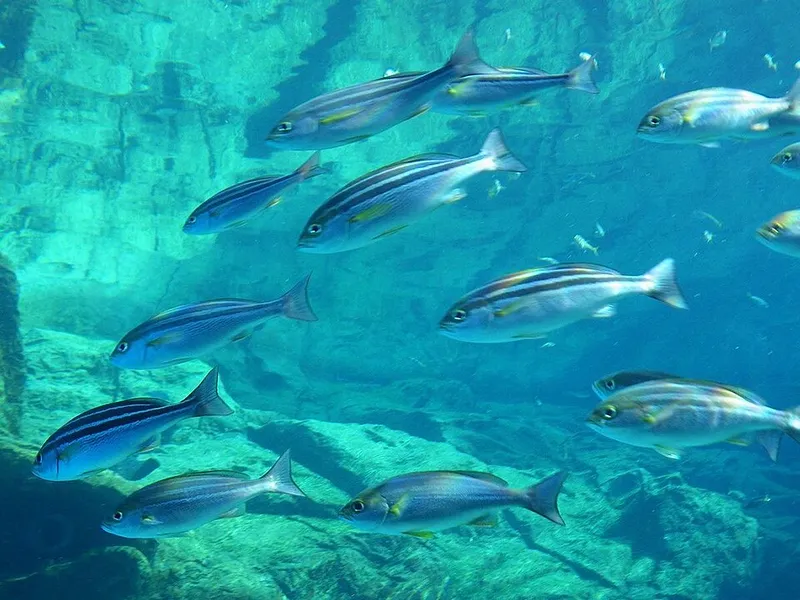
The rainy season is the peak, when pre-spawning shoals come within reach of both rock marks and boats. On summer nights they ride high in the water, so the better fish come after dark. Late-autumn fish carry more fat but arrive in smaller numbers.
About
Juveniles are brown with three yellow stripes along the upper flank, earning them the nickname uribo, "boar piglet"; the species name trilineatum comes from those three lines. The stripes fade with age and adults turn a plain blue-grey, reaching about 40 cm. It feeds by night, and is at its best in the early-summer rainy season before spawning.
Basics
Scientific name
Parapristipoma trilineatum
Family
Haemulidae (Grunts)
Japanese name
イサキ
Kana
いさき
Also called
イサギ, ウリボウ, イッサキ
Waters
Southern Pacific coast, East China Sea & western Kyushu, Sea of Japan
Size
30 cm (max 45 cm)
Time of day
Dusk, Night, Dawn
Depth (tana)
Mid-water to near the surface. They sit under the chum trail and rise at night, so shorten by a fathom at a time when nothing responds.
Ad slot
How to catch it
The rainy season is the peak. Boat anglers use a single-arm boom with a chum basket, while rock anglers fish a float-and-basket rig. Young-of-the-year come readily to sabiki rigs off breakwaters.
The fish come shallower as the light goes. Start at about three fathoms and shorten by one at a time if nothing happens; two light shakes of the cage is enough chum. On a rock mark after dark, knowing your way back comes first: wear a buoyant life jacket and never go alone.
Waters: Southern Pacific coast, East China Sea & western Kyushu, Sea of Japan
Drop a light jig of 30 to 60 g to the bottom, wind slowly for ten metres, then let it go again. The shoal sits a little above the seabed, so note the depth of the take and work only that band. The faster you get back down, the more you catch.
Waters: Southern Pacific coast, East China Sea & western Kyushu, Sea of Japan
Sabiki (bait-jig) fishing from a Breakwater / Pier
The young of the year, still showing three yellow stripes and known as uribo, come to the piers in shoals through summer. Smaller hooks than you would use for horse mackerel, worked close in, bring numbers. The dorsal spines are sharp, so hold the fish through a towel rather than gripping it.
Waters: Southern Pacific coast, East China Sea & western Kyushu, Sea of Japan
Kit for this fish
Float fishing starter kit ・ Kit total ¥13,000–30,000
Isozao (telescopic shore rod) #3, 3.6 mThe standard rod for sabiki and float fishing. Telescopic, so it packs short and handles easily on a pier. If you buy one rod, buy this.¥4,000–9,000AdFind on AmazonFind on Rakuten
Spinning reel, size 2500The most versatile size for pier fishing: one reel covers sabiki, float fishing and eging.¥4,000–15,000AdFind on AmazonFind on Rakuten
Nylon line, 2-gou (about 8 lb)The standard for chonage and float fishing. Its stretch absorbs sudden runs and forgives an imperfect knot.¥600–2,000AdFind on AmazonFind on Rakuten
Float rig set (stick float / cone float)A pack with float, stopper, split shot and hook. It is all you need to start practising depth changes.¥500–1,500AdFind on AmazonFind on Rakuten
Okiami krill (raw or boiled)The hook bait for float and fukase fishing. Boiled stands up to bait thieves; raw gets more bites.¥400–1,200AdFind on AmazonFind on Rakuten
Rope bucket for drawing seawaterUsed to rinse hands and chum and to keep fish alive. It is also how you leave the pier clean.¥800–2,500AdFind on AmazonFind on Rakuten
Fishing pliers / hook removerEssential protection from venomous spines and sharp teeth. Most injuries happen when someone unhooks a fish bare-handed.¥800–4,000AdFind on AmazonFind on Rakuten
Cool box, 15-20 LFor carrying fish home cold. Take plenty of ice; in summer a poorly insulated box is not fit for the job.¥4,000–25,000AdFind on AmazonFind on Rakuten
Life jacket, adult (Japan Craft Inspection approved)The first thing to buy, and worn on piers, rocks and boats alike. Boat fishing requires the government-approved type marked with the cherry-blossom stamp.¥5,000–20,000AdFind on AmazonFind on Rakuten
Shares the rod and reel with the sabiki kit. The whole craft is in moving the stopper to find the depth.
Product links may be affiliate links. Prices move, so treat the ranges as a guide.
The dorsal spines are hard and sharp. There is no strong venom, but you handle a great many of these in a session and gripping one drives a spine in. Cutting the dorsal fin away with scissors before you bleed the fish makes everything afterwards safer. The bones are stiff and sharply pointed too, and lodging one in the throat is a long-standing hazard when eating it.
Sashimi, salt-grilled, or simmered. Rainy-season fish carry fat, and searing the skin brings out the aroma. The small bones are stiff and sharp, so flake the flesh before serving it to children.
Best eating: May–July
Rules
Some prefectures set a minimum size in their fishery regulations. Many rock marks and piers are also closed at night, so check both the local rules and the signage on site.