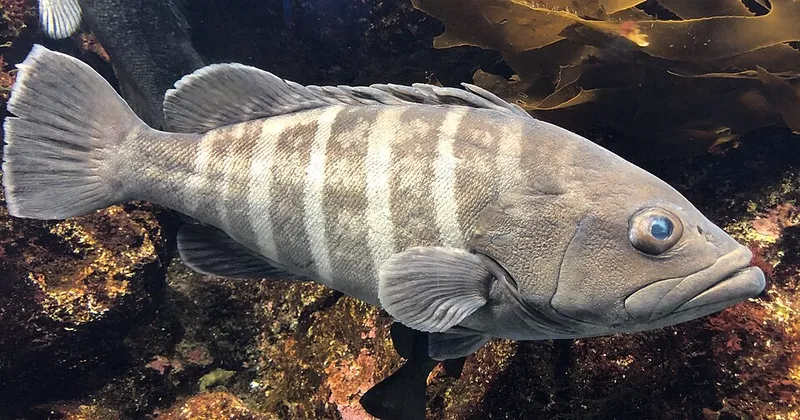
Juveniles hang around shallow rock, but as they grow they drop to reefs in fifty to two hundred metres. The boat season runs from spring to late autumn and is steadiest in early summer. It is said to eat best in summer, though winter demand for hotpots keeps its value high.
About
Young fish carry seven black bars that fade with age. It grows to a metre and is a luxury fish, served as sashimi or in hot pot.
Basics
Scientific name
Epinephelus septemfasciatus
Family
Epinephelidae (Groupers)
Japanese name
マハタ
Kana
まはた
Also called
ハタ, カンナギ
Waters
Southern Pacific coast, East China Sea & western Kyushu, Sea of Japan
Size
50 cm (max 120 cm)
Time of day
Dawn, Daytime
Depth (tana)
Two or three metres off the bottom. Hold the bait just above the top of the reef and keep the line tight at all times so the fish cannot get back into the rock.
Ad slot
How to catch it
Targeted from boats over rocky ground 50 to 200 meters down. A live sardine on a two-hook rig is the mainstay, while jigging and light tenya rigs work for smaller fish.
Wet your hands before hooking a live sardine so it stays lively, then drop to the bottom and wind up a metre or two. Give line until the fish has it, and only strike once the weight is there. The first few metres decide it, because a running fish heads straight for the rock.
Waters: Southern Pacific coast, East China Sea & western Kyushu, Sea of Japan
Drop a jig of around two hundred grams to the bottom and work it in slow, wide sweeps through the first ten metres. The water is deep and the tide fast, so save your strength for the marks the skipper points out.
Waters: Southern Pacific coast, East China Sea & western Kyushu, Sea of Japan
From the rocks you are realistically after middling fish. Drop a small horse mackerel or cardinalfish caught on the spot beside a submerged rock and wait on a tight line. Once hooked, the whole fight is about pulling it away from the reef.
Waters: Southern Pacific coast, East China Sea & western Kyushu, Sea of Japan
Kit for this fish
Live-bait fishing kit ・ Kit total ¥25,000–60,000
Isozao #4-5, 4.5 mFor live-bait (nomase) fishing: strong enough to cast a live baitfish and to stop a running jack.¥8,000–25,000AdFind on AmazonFind on Rakuten
Spinning reel, size 3000For surf casting and live-bait fishing: holds more line and stands up to mid-sized fish.¥5,000–18,000AdFind on AmazonFind on Rakuten
Nylon line, 5-gou (about 20 lb)Main line for live-bait fishing, giving margin once something large is on.¥800–2,500AdFind on AmazonFind on Rakuten
Live-bait rig (elevator or float type)Designed to let a live baitfish swim without tiring. The elevator type slides the bait down the main line, so you never have to recast it.¥400–1,500AdFind on AmazonFind on Rakuten
Rope bucket for drawing seawaterUsed to rinse hands and chum and to keep fish alive. It is also how you leave the pier clean.¥800–2,500AdFind on AmazonFind on Rakuten
Landing net with 5 m handlePiers sit high above the water and heavy fish break off if you lift them. Having one changes what you land.¥4,000–20,000AdFind on AmazonFind on Rakuten
Knife and spike for bleeding fishWhat turns a caught fish into good food; bleeding it changes the taste. See the column "Killing and carrying your catch" for how to use them.¥1,000–6,000AdFind on AmazonFind on Rakuten
Cool box, 15-20 LFor carrying fish home cold. Take plenty of ice; in summer a poorly insulated box is not fit for the job.¥4,000–25,000AdFind on AmazonFind on Rakuten
Life jacket, adult (Japan Craft Inspection approved)The first thing to buy, and worn on piers, rocks and boats alike. Boat fishing requires the government-approved type marked with the cherry-blossom stamp.¥5,000–20,000AdFind on AmazonFind on Rakuten
The bait is normally caught on site with a sabiki rig, so bring that kit too. You need a bucket, ideally aerated, to keep the bait alive.
Product links may be affiliate links. Prices move, so treat the ranges as a guide.
The dorsal spines are thick and hard and the gill covers are sharp-edged. No venom is recorded, but a large fish is powerful and trying to hold one bare-handed will cut you badly. On deck, clamp the jaw with a grip and use pliers on the hook.
Sashimi, hotpot, or simmered. There is a gelatinous layer between skin and flesh that comes into its own blanched or in a pot, and the frame yields a fine stock.
Best eating: June–August
Rules
Check the local prefectural fishery regulation. Individual charter boats often set their own bag limits or release rules for small fish, so ask before you board.