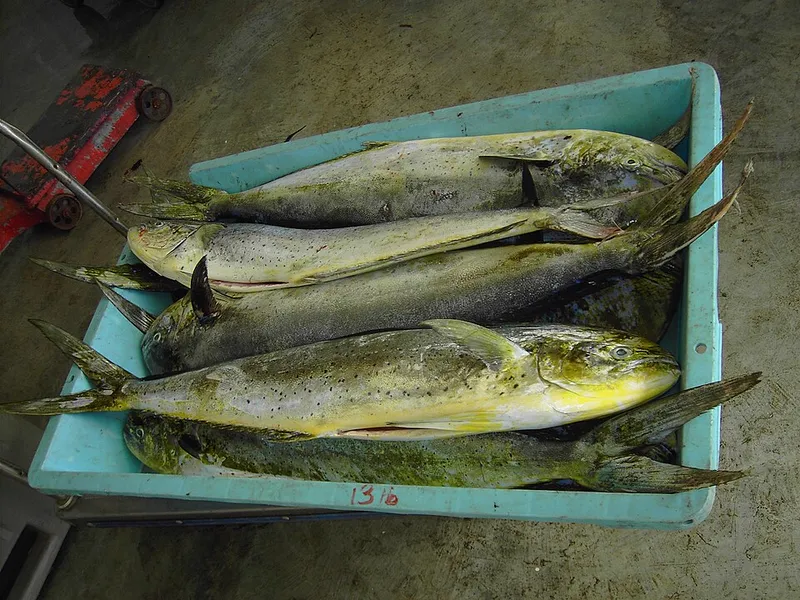
A fish of summer and autumn, when the warm current pushes in. It gathers under anything afloat, driftwood or a fish-aggregating buoy, so the search is for the object rather than the fish. When the water cools it leaves for open sea at once.
About
Males develop a steep, blunt forehead. The fish shimmers gold and blue in the water but fades fast once landed. In Hawaii it is known as mahi-mahi.
Basics
Scientific name
Coryphaena hippurus
Family
シイラ科
Japanese name
シイラ
Kana
しいら
Also called
マンビキ, マヒマヒ, トウヒャク
Waters
Southern Pacific coast, East China Sea & western Kyushu, Okinawa & Nansei Islands
Size
90 cm (max 180 cm)
Time of day
Dawn, Daytime, Dusk
Depth (tana)
At the surface. Fish come out from the shade of the object, so run the lure past its downwind edge rather than straight over it.
Local names
マンビキ
Ad slot
How to catch it
Lure fishing from boats in summer and autumn is the standard. The fish gather around driftwood and payao fish-aggregating buoys, so anglers cast metal jigs and poppers there; the hard fight makes it a good introduction to offshore casting.
Cast to the downwind side of the driftwood or buoy and start the retrieve fast the moment it lands. One hooked fish brings the shoal up, so the next angler should cast straight away. A landed fish thrashes hard with the lure still in its jaw: pin it with a grip before you go near it with pliers.
Waters: Southern Pacific coast, East China Sea & western Kyushu, Okinawa & Nansei Islands
In summer the shoals sometimes come within casting range of a shore mark or the end of a breakwater with good flow. Retrieve fast at the surface and do not pause when one follows. A big fish cannot be lifted up the rock, so bring a net: trying to muscle one out is how people go in.
Waters: Southern Pacific coast, East China Sea & western Kyushu, Okinawa & Nansei Islands
Kit for this fish
Shore jigging kit ・ Kit total ¥40,000–100,000
Shore jigging rod, 10 ft, MHLong and powerful enough to cast 40-60 g jigs and to absorb the runs of a hooked jack.¥12,000–40,000AdFind on AmazonFind on Rakuten
Spinning reel, size 4000-5000For shore jigging. A smooth drag under a running fish matters more than anything here, so this is not the place to economise.¥10,000–35,000AdFind on AmazonFind on Rakuten
PE braid, 1.5-2 gouFor shore jigging: the compromise between casting distance and strength.¥2,000–6,000AdFind on AmazonFind on Rakuten
Fluorocarbon leaderThe clear line tied to the end of the braid. It resists abrasion and is less visible, protecting the braid from rock and teeth.¥800–3,000AdFind on AmazonFind on Rakuten
Metal jig, 30-60 gThe mainstay of shore jigging. Carry the same shape in several weights and switch with wind and current.¥600–2,500AdFind on AmazonFind on Rakuten
Landing net with 5 m handlePiers sit high above the water and heavy fish break off if you lift them. Having one changes what you land.¥4,000–20,000AdFind on AmazonFind on Rakuten
Fishing pliers / hook removerEssential protection from venomous spines and sharp teeth. Most injuries happen when someone unhooks a fish bare-handed.¥800–4,000AdFind on AmazonFind on Rakuten
Knife and spike for bleeding fishWhat turns a caught fish into good food; bleeding it changes the taste. See the column "Killing and carrying your catch" for how to use them.¥1,000–6,000AdFind on AmazonFind on Rakuten
Cool box, 15-20 LFor carrying fish home cold. Take plenty of ice; in summer a poorly insulated box is not fit for the job.¥4,000–25,000AdFind on AmazonFind on Rakuten
Life jacket, adult (Japan Craft Inspection approved)The first thing to buy, and worn on piers, rocks and boats alike. Boat fishing requires the government-approved type marked with the cherry-blossom stamp.¥5,000–20,000AdFind on AmazonFind on Rakuten
Studded or felt-soled bootsOrdinary shoes slip on rock and tetrapods. Falls are the most common cause of accidents, so these are mandatory for rocky shores.¥4,000–15,000AdFind on AmazonFind on Rakuten
You will often be on rocks or the tip of a breakwater at dawn, where safety gear matters more than results. Do not go alone.
Product links may be affiliate links. Prices move, so treat the ranges as a guide.
The flesh is high in histidine, and as freshness drops it converts to histamine, a known cause of food poisoning with facial flushing, hives and headache. Histamine is not destroyed by heat, so neither grilling nor frying will make it safe. Bleed the fish the moment it is aboard, pack it in an iced cool box, and never let it sit at ambient temperature. A large fish soon exhausts your ice, so decide how many you will keep before you start.
Rows of fine, rasping teeth will graze a finger, but the greater danger comes after landing: it thrashes violently on deck with the lure still in its jaw, and a freed hook can go into someone. Pin the head with a grip, keep your face away, and use pliers. Do not leave one loose at your feet until it has settled.
Fried, as meuniere, or cooked in butter: a light white flesh that suits heat. Keep it for sashimi only if it was bled and iced without delay.
Best eating: July–September
Rules
Offshore fish-aggregating buoys and set nets belong to commercial fisheries, and fishing around them is restricted in places. Follow the skipper's instructions on a party boat, and check the prefectural fishery regulation.