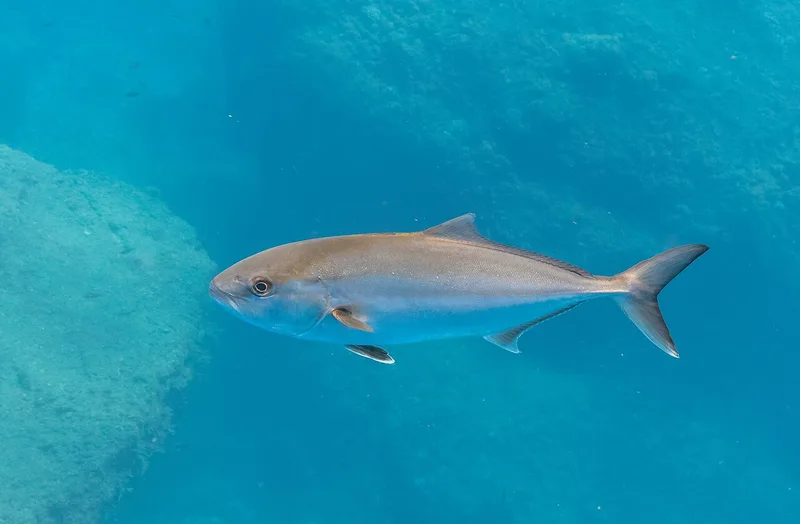
It prefers warmer water than the amberjack. From piers you mostly meet the small ones, called shogo, taken on live bait or jigs.
About
A brown band runs from the top of the head through the eye to the upper jaw; seen head-on it resembles the character for eight, hachi, which is where the Japanese name comes from. The band is bold in young fish and fades with age. The back is yellow-brown shading to pale purple, and the body is deeper and more compressed than that of the Japanese amberjack or the yellowtail amberjack. Most are about a metre long, but the record is 1.9 m, making it one of the largest of all jacks, and its sashimi has a firm bite.
Basics
Scientific name
Seriola dumerili
Family
Carangidae (Jacks)
Japanese name
カンパチ
Kana
かんぱち
Also called
ショゴ, しょご, アカハナ
Waters
Southern Pacific coast, East China Sea & western Kyushu, Okinawa & Nansei Islands
Size
60 cm (max 150 cm)
Time of day
Dawn, Dusk
Depth (tana)
Mid-water, usually working deeper than amberjack, and holding around submerged rock and headlands with strong flow.
Ad slot
How to catch it
Offshore anglers take it on metal jigs or live bait. Juveniles, called shogo, come within reach of breakwaters and rocky shores on lures, with July to October the hottest months.
Nomase (live bait) fishing from a Breakwater / Pier
Dropped straight down from the boat and worked back with a fast one-pitch retrieve. It is exhausting, so concentrate your effort on the morning window, and fish the depth the skipper tells you.
Waters: Sea of Japan, Southern Pacific coast, East China Sea & western Kyushu, Okinawa & Nansei Islands
Kit for this fish
Live-bait fishing kit ・ Kit total ¥25,000–60,000
Isozao #4-5, 4.5 mFor live-bait (nomase) fishing: strong enough to cast a live baitfish and to stop a running jack.¥8,000–25,000AdFind on AmazonFind on Rakuten
Spinning reel, size 3000For surf casting and live-bait fishing: holds more line and stands up to mid-sized fish.¥5,000–18,000AdFind on AmazonFind on Rakuten
Nylon line, 5-gou (about 20 lb)Main line for live-bait fishing, giving margin once something large is on.¥800–2,500AdFind on AmazonFind on Rakuten
Live-bait rig (elevator or float type)Designed to let a live baitfish swim without tiring. The elevator type slides the bait down the main line, so you never have to recast it.¥400–1,500AdFind on AmazonFind on Rakuten
Rope bucket for drawing seawaterUsed to rinse hands and chum and to keep fish alive. It is also how you leave the pier clean.¥800–2,500AdFind on AmazonFind on Rakuten
Landing net with 5 m handlePiers sit high above the water and heavy fish break off if you lift them. Having one changes what you land.¥4,000–20,000AdFind on AmazonFind on Rakuten
Knife and spike for bleeding fishWhat turns a caught fish into good food; bleeding it changes the taste. See the column "Killing and carrying your catch" for how to use them.¥1,000–6,000AdFind on AmazonFind on Rakuten
Cool box, 15-20 LFor carrying fish home cold. Take plenty of ice; in summer a poorly insulated box is not fit for the job.¥4,000–25,000AdFind on AmazonFind on Rakuten
Life jacket, adult (Japan Craft Inspection approved)The first thing to buy, and worn on piers, rocks and boats alike. Boat fishing requires the government-approved type marked with the cherry-blossom stamp.¥5,000–20,000AdFind on AmazonFind on Rakuten
The bait is normally caught on site with a sabiki rig, so bring that kit too. You need a bucket, ideally aerated, to keep the bait alive.
Product links may be affiliate links. Prices move, so treat the ranges as a guide.