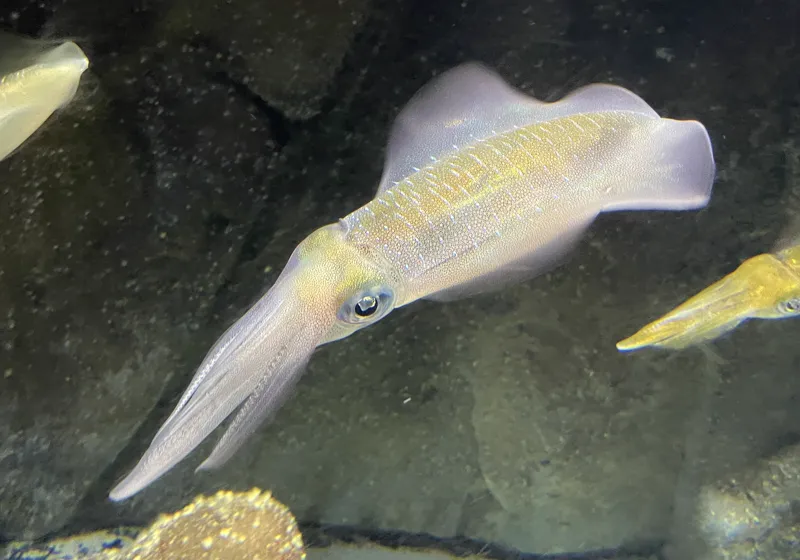
Spring (April-June) brings large spawning squid; autumn (September-November) brings numbers of small ones. The same pier calls for different egi sizes and a different rhythm in each season.
About
A large squid whose broad fin runs the entire length of the mantle, and the main quarry of eging. In spring the adults move into the shallows to lay eggs among seaweed, and in autumn the young hatched that year appear in schools close to shore. It lives roughly one year, hatching, growing, spawning and dying within it. The translucent flesh is notably sweet and rated among the finest of all squid.
Basics
Scientific name
Sepioteuthis lessoniana
Family
Loliginidae (Pencil squids)
Japanese name
アオリイカ
Kana
あおりいか
Also called
アオリ, ミズイカ, モイカ, バショウイカ
Waters
Sea of Japan, Northern Pacific coast, Southern Pacific coast, Seto Inland Sea, East China Sea & western Kyushu, Okinawa & Nansei Islands
Size
30 cm (max 50 cm)
Time of day
Dawn, Dusk, Night
Depth (tana)
Near the bottom. The standard is to confirm the egi has landed before starting to work it, changing egi size with depth and current.
Local names
モイカ, シロイカ
Ad slot
How to catch it
Sink the egi, snap it sharply upward, then let it drop on a tight line: the squid takes it during that fall. They react to the sinking lure, so what separates a good angler is not how hard they jerk but whether they can create a controlled, tight-line fall. In spring work the edges of the weed beds; in autumn try harbour lights and the tips of breakwaters where the water moves.
Eging (squid jigging with egi) from a Breakwater / Pier
Confirm the egi has landed, snap it up two or three times, then let it sink for ten seconds on a tight line. The squid takes it during that fall, so concentrate on falling cleanly rather than on how hard you jerk.
Waters: Sea of Japan, Southern Pacific coast, Seto Inland Sea, East China Sea & western Kyushu, Okinawa & Nansei Islands
The big spring squid sit along the edges of the weed beds. On rock you will lose egi to snags, so carry plenty of spares, and if the footing is wet, the decision not to go on comes first.
Waters: Sea of Japan, Southern Pacific coast, East China Sea & western Kyushu, Okinawa & Nansei Islands
Nomase (live bait) fishing from a Breakwater / Pier
A distinctly Japanese method: a live horse mackerel is sent out, and once a squid has taken hold, a sliding gaff called a yaen is run down the line to it. Everything depends on getting the yaen there before the squid lets go.
Waters: Sea of Japan, Southern Pacific coast, Seto Inland Sea, East China Sea & western Kyushu
Kit for this fish
Eging kit ・ Kit total ¥28,000–70,000
Eging rod, 8.6 ft, MediumA crisp rod for snapping the egi upward. At 8.6 ft it is the standard length that works from piers, rocks and beaches alike.¥8,000–30,000AdFind on AmazonFind on Rakuten
Spinning reel, size 2500The most versatile size for pier fishing: one reel covers sabiki, float fishing and eging.¥4,000–15,000AdFind on AmazonFind on Rakuten
PE braid, 0.6-gouThe eging standard. With no stretch, both the snap you give the egi and the weight of a squid come straight back to your hand.¥1,500–4,500AdFind on AmazonFind on Rakuten
Fluorocarbon leaderThe clear line tied to the end of the braid. It resists abrasion and is less visible, protecting the braid from rock and teeth.¥800–3,000AdFind on AmazonFind on Rakuten
Egi (squid jig), size 3.5The reference size for eging. Use 2.5-3 for small autumn squid and 3.5-4 for large spring spawners.¥700–2,000AdFind on AmazonFind on Rakuten
Landing net with 5 m handlePiers sit high above the water and heavy fish break off if you lift them. Having one changes what you land.¥4,000–20,000AdFind on AmazonFind on Rakuten
Waterproof headlampEssential for night fishing; keeping both hands free is itself a safety measure. Etiquette is never to shine it at people or straight onto the water.¥1,500–8,000AdFind on AmazonFind on Rakuten
Cool box, 15-20 LFor carrying fish home cold. Take plenty of ice; in summer a poorly insulated box is not fit for the job.¥4,000–25,000AdFind on AmazonFind on Rakuten
Life jacket, adult (Japan Craft Inspection approved)The first thing to buy, and worn on piers, rocks and boats alike. Boat fishing requires the government-approved type marked with the cherry-blossom stamp.¥5,000–20,000AdFind on AmazonFind on Rakuten
No bait costs, but a higher up-front spend. You will lose egi to snags, so carry several of the same size.
Product links may be affiliate links. Prices move, so treat the ranges as a guide.
It has a hard beak, called karasu-tonbi, that can break the skin if it bites. It also squirts ink forcefully, so hold it pointing out to sea to keep it off your clothes and the pier.
Sashimi, tempura, or lightly dried overnight. The flesh is translucent when fresh and turns white and sweeter after resting.
Best eating: April, May, October, November
Rules
The seagrass beds where it spawns are sometimes protected, and some prefectures restrict areas or seasons. Harbours also contain many closed areas. Always check both the local regulation and the signage on site.