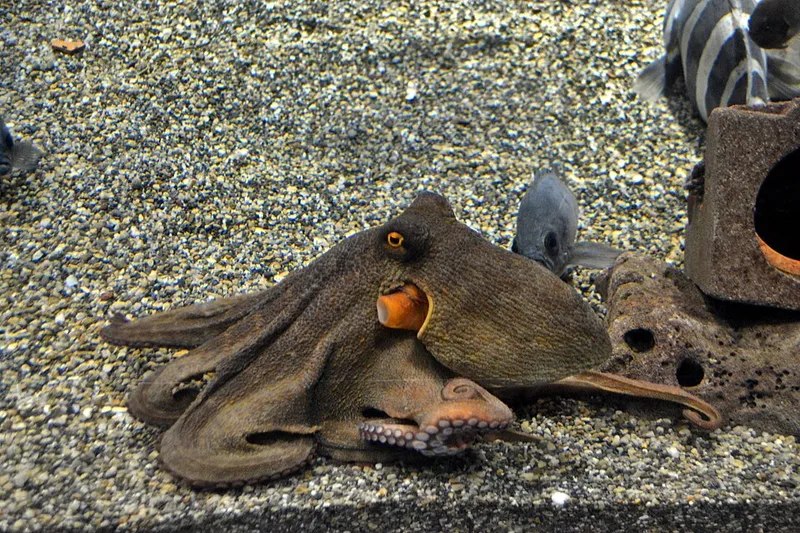
The season is the summer shallows. Note, though, that in some areas it falls under common fishery rights and fishing for it is not permitted.
About
The familiar octopus of the rip-rap and tetrapod gaps along a breakwater. It takes crabs and shellfish with its eight arms and changes both colour and skin texture to match its surroundings. It moves into shallow water in summer, when it can be taken from piers on octopus jigs. Those from Akashi are especially renowned in western Japan.
Basics
Scientific name
Octopus sinensis
Family
Octopodidae (Octopuses)
Japanese name
マダコ
Kana
まだこ
Also called
タコ, たこ, アカシダコ
Waters
Sea of Japan, Northern Pacific coast, Southern Pacific coast, Seto Inland Sea, East China Sea & western Kyushu
Size
40 cm (max 100 cm)
Time of day
Dawn, Daytime, Dusk
Depth (tana)
On the bottom, worked while staying in contact with it the whole time.
Local names
明石ダコ
Ad slot
How to catch it
Put an octopus jig on the bottom, shake it in place to draw the animal on, then pull it clear in one decisive movement, because once it grips the rock with its suckers you have lost it. It is a walking fishery, working the rip-rap and tetrapod edges methodically. Before you go, confirm that taking octopus is permitted at that spot.
Eging (squid jigging with egi) from a Breakwater / Pier
Keep the octopus jig on the bottom, shake it in place, and when weight loads up, pull it free in one movement; hesitate and the suckers lock onto the rock. Before you go, confirm that taking octopus is permitted at that spot and that it is not covered by common fishery rights.
Waters: Sea of Japan, Northern Pacific coast, Southern Pacific coast, Seto Inland Sea, East China Sea & western Kyushu
Kit for this fish
Eging kit ・ Kit total ¥28,000–70,000
Eging rod, 8.6 ft, MediumA crisp rod for snapping the egi upward. At 8.6 ft it is the standard length that works from piers, rocks and beaches alike.¥8,000–30,000AdFind on AmazonFind on Rakuten
Spinning reel, size 2500The most versatile size for pier fishing: one reel covers sabiki, float fishing and eging.¥4,000–15,000AdFind on AmazonFind on Rakuten
PE braid, 0.6-gouThe eging standard. With no stretch, both the snap you give the egi and the weight of a squid come straight back to your hand.¥1,500–4,500AdFind on AmazonFind on Rakuten
Fluorocarbon leaderThe clear line tied to the end of the braid. It resists abrasion and is less visible, protecting the braid from rock and teeth.¥800–3,000AdFind on AmazonFind on Rakuten
Egi (squid jig), size 3.5The reference size for eging. Use 2.5-3 for small autumn squid and 3.5-4 for large spring spawners.¥700–2,000AdFind on AmazonFind on Rakuten
Landing net with 5 m handlePiers sit high above the water and heavy fish break off if you lift them. Having one changes what you land.¥4,000–20,000AdFind on AmazonFind on Rakuten
Waterproof headlampEssential for night fishing; keeping both hands free is itself a safety measure. Etiquette is never to shine it at people or straight onto the water.¥1,500–8,000AdFind on AmazonFind on Rakuten
Cool box, 15-20 LFor carrying fish home cold. Take plenty of ice; in summer a poorly insulated box is not fit for the job.¥4,000–25,000AdFind on AmazonFind on Rakuten
Life jacket, adult (Japan Craft Inspection approved)The first thing to buy, and worn on piers, rocks and boats alike. Boat fishing requires the government-approved type marked with the cherry-blossom stamp.¥5,000–20,000AdFind on AmazonFind on Rakuten
No bait costs, but a higher up-front spend. You will lose egi to snags, so carry several of the same size.
Product links may be affiliate links. Prices move, so treat the ranges as a guide.
A hard beak sits at the centre of the arms and a bite can draw blood. Hold the body and keep bare hands away from the mouth. Do not touch a small octopus showing blue rings or lines; treat it as a possible blue-ringed octopus, a different species.
Boiled and served as sashimi, in vinegared dishes, or cooked with rice. The key preparation is rubbing it thoroughly with salt to remove the slime.
Best eating: January, June–August, December
Rules
In many areas octopus is covered by common fishery rights, and recreational take is prohibited or restricted. Taking one without permission can be treated as poaching and carries penalties, so always check the prefectural fishery regulation and the local cooperative's rules before you go. Free-diving for them or taking them by hand is especially likely to be an offence.