Target the spring spawning period and the autumn-to-winter growth of the young. Fishing a step deeper than you would for bigfin reef squid makes it much easier.
About
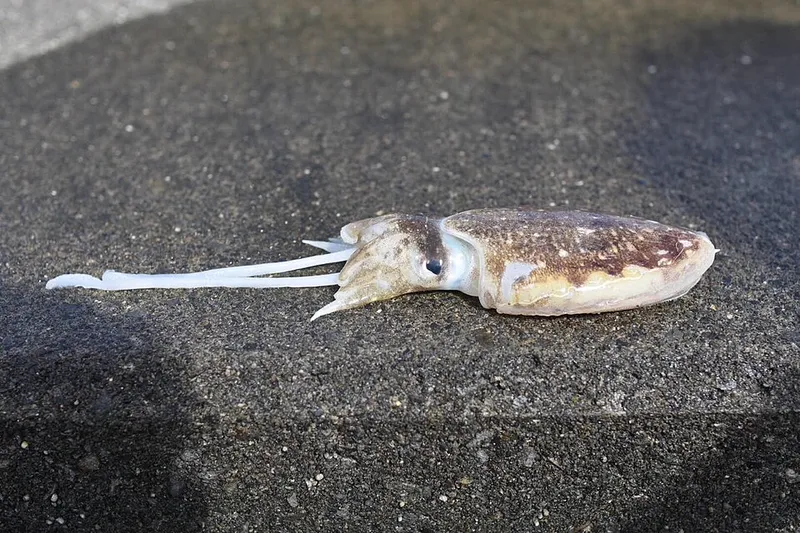
A cuttlefish with a hard calcareous internal shell, recognised by its rounded mantle and short fins. It lives close to sand and mud bottoms, deeper than the bigfin reef squid. It is also called sumi-ika, the ink squid, for how much ink it releases. The flesh is thick and stays tender even when cooked.
Basics
Scientific name
Sepia esculenta
Family
Sepiidae (Cuttlefishes)
Japanese name
コウイカ
Kana
こういか
Also called
スミイカ, ハリイカ, マイカ
Waters
Sea of Japan, Southern Pacific coast, Seto Inland Sea, East China Sea & western Kyushu
Size
20 cm (max 30 cm)
Time of day
Dawn, Daytime, Dusk
Depth (tana)
On the bottom. Let it land before moving it; lift it off the bottom and you will not catch.
Local names
スミイカ
Ad slot
How to catch it
Sink the egi to the bottom, hop it in small movements that kick up sand, then pause, and repeat. The big sweeping jerks used for bigfin reef squid are unnecessary; this is a patient, bottom-tapping fishery. Adding a small sutte jig above the egi is common, as is tenya fishing from a boat.
Eging (squid jigging with egi) from a Breakwater / Pier
Unlike the bigfin reef squid it will not leave the bottom. Hop the egi in small movements that raise sand and always let it settle back down. It releases a great deal of ink, so point it out to sea as you lift it.
Waters: Sea of Japan, Southern Pacific coast, Seto Inland Sea, East China Sea & western Kyushu
Kit for this fish
Eging kit ・ Kit total ¥28,000–70,000
Eging rod, 8.6 ft, MediumA crisp rod for snapping the egi upward. At 8.6 ft it is the standard length that works from piers, rocks and beaches alike.¥8,000–30,000AdFind on AmazonFind on Rakuten
Spinning reel, size 2500The most versatile size for pier fishing: one reel covers sabiki, float fishing and eging.¥4,000–15,000AdFind on AmazonFind on Rakuten
PE braid, 0.6-gouThe eging standard. With no stretch, both the snap you give the egi and the weight of a squid come straight back to your hand.¥1,500–4,500AdFind on AmazonFind on Rakuten
Fluorocarbon leaderThe clear line tied to the end of the braid. It resists abrasion and is less visible, protecting the braid from rock and teeth.¥800–3,000AdFind on AmazonFind on Rakuten
Egi (squid jig), size 3.5The reference size for eging. Use 2.5-3 for small autumn squid and 3.5-4 for large spring spawners.¥700–2,000AdFind on AmazonFind on Rakuten
Landing net with 5 m handlePiers sit high above the water and heavy fish break off if you lift them. Having one changes what you land.¥4,000–20,000AdFind on AmazonFind on Rakuten
Waterproof headlampEssential for night fishing; keeping both hands free is itself a safety measure. Etiquette is never to shine it at people or straight onto the water.¥1,500–8,000AdFind on AmazonFind on Rakuten
Cool box, 15-20 LFor carrying fish home cold. Take plenty of ice; in summer a poorly insulated box is not fit for the job.¥4,000–25,000AdFind on AmazonFind on Rakuten
Life jacket, adult (Japan Craft Inspection approved)The first thing to buy, and worn on piers, rocks and boats alike. Boat fishing requires the government-approved type marked with the cherry-blossom stamp.¥5,000–20,000AdFind on AmazonFind on Rakuten
No bait costs, but a higher up-front spend. You will lose egi to snags, so carry several of the same size.
Product links may be affiliate links. Prices move, so treat the ranges as a guide.
It bites with a hard beak, and it produces a great deal of ink. Point it out to sea when you lift it and let it discharge before bringing it onto the pier, and never leave the ink behind when you go.