It moves shallow from winter into spring, and because that is also when it fattens before spawning, the catching season and the eating season coincide, which is unusual. In summer the fish scatter into deep water, so the window is short.
About
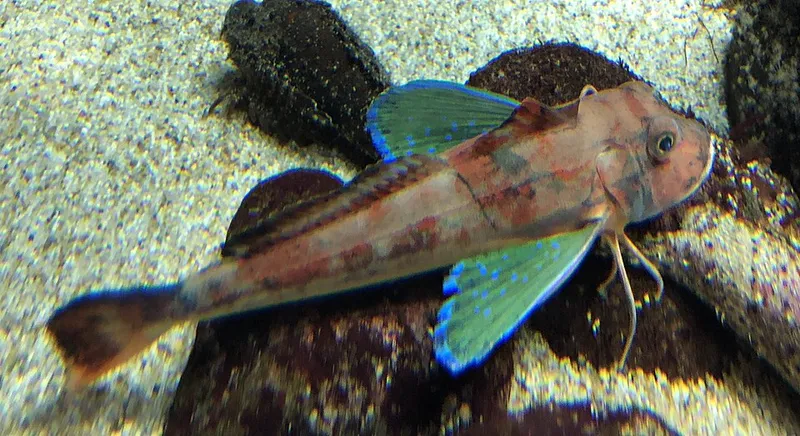
Its pectoral fins spread like brilliant blue-green fans. Part of each fin is split into finger-like rays that it uses to walk along the seabed.
Basics
Scientific name
Chelidonichthys spinosus
Family
ホウボウ科
Japanese name
ホウボウ
Kana
ほうぼう
Waters
Northern Pacific coast, Southern Pacific coast, Sea of Japan, East China Sea & western Kyushu
Size
30 cm (max 45 cm)
Time of day
Dawn, Daytime
Depth (tana)
Hard on the bottom. It walks over sand and mud on its pectoral rays, so keep the rig dragging along the seabed at all times.
Ad slot
How to catch it
It lives over sand and mud, so it turns up in mixed-bag boat fishing and in trips aimed at whiting or flounder. Sea worms and shrimp are the usual baits.
It comes while you are surfcasting for whiting or flounder. Leave a long tail on the worm, keep the rig on the seabed and drag it slowly. The bite is a heavy, deliberate pull, and once hooked the fish does not run far.
Waters: Northern Pacific coast, Southern Pacific coast, Sea of Japan, East China Sea & western Kyushu
Drifting a tairaba over mixed sand while fishing for seabream turns them up regularly. Takes come within five metres of the bottom, so start winding as soon as the lure lands and drop it back after about ten turns.
Waters: Northern Pacific coast, Southern Pacific coast, Sea of Japan, East China Sea & western Kyushu
Kit for this fish
Surf casting kit ・ Kit total ¥22,000–60,000
Surf rod, 4.25 m, 27-gouA true surf rod for launching heavy sinkers to distant ground. Always check behind you before casting.¥8,000–30,000AdFind on AmazonFind on Rakuten
Spinning reel, size 3000For surf casting and live-bait fishing: holds more line and stands up to mid-sized fish.¥5,000–18,000AdFind on AmazonFind on Rakuten
Nylon line, 3-gou (about 12 lb)For sabiki and hole fishing. Thick enough to resist abrasion on rock and to horse a rockfish straight up.¥600–2,000AdFind on AmazonFind on Rakuten
Jet tenbin sinker, 15-25 gouThe long-range sinker for surf casting. It lifts as you retrieve, which reduces snags.¥300–900AdFind on AmazonFind on Rakuten
Whiting rig (2-3 hooks)A surf rig of small, fine-wire hooks matched to the small mouth of Japanese whiting.¥300–900AdFind on AmazonFind on Rakuten
Flounder rig (single-arm sinker, 2 hooks, attractor beads)A winter surf rig; the fluorescent beads make it visible in coloured water.¥400–1,200AdFind on AmazonFind on Rakuten
Aoisome (green sandworm / Nereis)The most versatile worm bait, usable for chonage, surf, hole and float fishing alike. Its movement is the attraction, so do not cut it too short.¥500–1,200AdFind on AmazonFind on Rakuten
Rod stand / tripodFor resting a rod during surf fishing. A rod laid on the ground damages its guides and can be washed away.¥2,000–10,000AdFind on AmazonFind on Rakuten
Cool box, 15-20 LFor carrying fish home cold. Take plenty of ice; in summer a poorly insulated box is not fit for the job.¥4,000–25,000AdFind on AmazonFind on Rakuten
Life jacket, adult (Japan Craft Inspection approved)The first thing to buy, and worn on piers, rocks and boats alike. Boat fishing requires the government-approved type marked with the cherry-blossom stamp.¥5,000–20,000AdFind on AmazonFind on Rakuten
Cap and polarised sunglassesAlso safety equipment, protecting your eyes from a flying rig. Polarised lenses additionally let you read the bottom.¥2,000–20,000AdFind on AmazonFind on Rakuten
You are swinging a heavy sinker, so checking behind you and keeping distance from others is the core of safety here. The cap and glasses are included as eye protection.
Product links may be affiliate links. Prices move, so treat the ranges as a guide.
It is not venomous, but the two long spines projecting behind the head, the gill-cover spines and the dorsal are all extremely hard and sharp, and gripping it over the head is a certain puncture. It thrashes with its pectoral fins spread, so put it down first, take the jaw with a grip, and only then reach for the hook.
Sashimi, hotpot, or simmered. The translucent white flesh is fine, and the head and frame give a clear, first-rate stock. A winter fish makes notably sweet sashimi.
Best eating: January–March, December
Rules
Check the prefectural fishery regulation. On charter boats the skipper's own rules apply as well, so ask before you board.