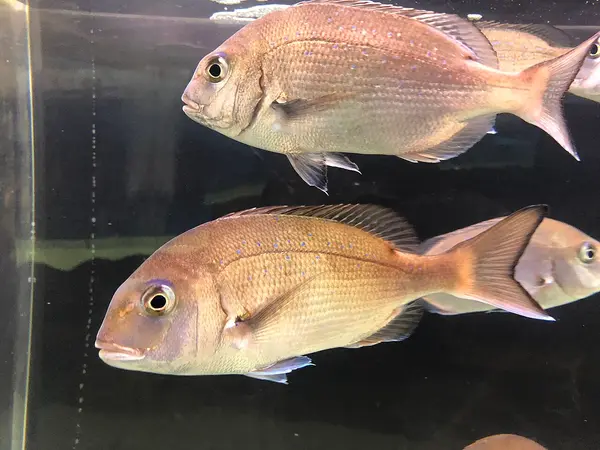
Easiest to catch in spring before spawning, the nokkomi run, but best eating in winter when it carries fat. It is the textbook case of catching season and eating season not matching.
About
Japan's most celebrated fish, often called the king of fish. Its glossy pink body is dusted with small blue spots, and the black rear edge of the tail fin sets it apart from the crimson and yellowback seabreams. It lives near rocky and gravelly bottoms in 30-200 m of water, crushing crabs and shellfish with powerful teeth. Indispensable at celebrations, and widely farmed.
Basics
Scientific name
Pagrus major
Family
Sparidae (Seabreams and Porgies)
Japanese name
マダイ
Kana
まだい
Also called
タイ, たい, チャリコ
Waters
Sea of Japan, Northern Pacific coast, Southern Pacific coast, Seto Inland Sea, East China Sea & western Kyushu
Size
40 cm (max 100 cm)
Time of day
Dawn, Daytime
Depth (tana)
Bottom to mid-water. On tairaba, most bites come in the first 10-20 m of the wind-up after touching bottom.
Local names
鳴門鯛
Ad slot
How to catch it
A mainstay of party-boat fishing. The three standard methods are tairaba (a lead head trailing a rubber skirt), hitotsu-tenya (a single weighted jig head baited with shrimp), and komase-madai, which chums with krill. Boats run year-round.
Retrieve at a constant speed after the lure hits bottom. Do not strike on the first tap; keep winding until the weight loads up, then lift the rod. Everything depends on holding the same rhythm without changing speed.
Fished by drifting chum from a rock mark with good tidal flow. A hooked fish runs hard and a fine leader will not hold it. Once you are standing on the rocks, gear and weather judgement come before catching anything.
Waters: Sea of Japan, Southern Pacific coast, Seto Inland Sea, East China Sea & western Kyushu
Kit for this fish
Tairaba starter kit ・ Kit total ¥30,000–80,000
Tairaba rod, 6.9 ftA dedicated rod with a very soft tip that lets the seabream take the lure without feeling resistance. A stiff rod simply pulls it away.¥10,000–35,000AdFind on AmazonFind on Rakuten
Small baitcasting reel with line counter (size 100-150)For tairaba. The line counter tells you the depth, so you can go straight back to the layer where the fish hit.¥8,000–30,000AdFind on AmazonFind on Rakuten
PE braid, 0.8-gouFor tairaba. The thinner the braid, the less the current pushes it, so the lure drops straight and you can feel the bottom.¥1,500–5,000AdFind on AmazonFind on Rakuten
Fluorocarbon leaderThe clear line tied to the end of the braid. It resists abrasion and is less visible, protecting the braid from rock and teeth.¥800–3,000AdFind on AmazonFind on Rakuten
Tairaba head 60-100 g with skirt and tailChoose head weight by depth and current. The rubber tails wear out, so carry spares in a few colours.¥1,000–3,500AdFind on AmazonFind on Rakuten
Fishing pliers / hook removerEssential protection from venomous spines and sharp teeth. Most injuries happen when someone unhooks a fish bare-handed.¥800–4,000AdFind on AmazonFind on Rakuten
Knife and spike for bleeding fishWhat turns a caught fish into good food; bleeding it changes the taste. See the column "Killing and carrying your catch" for how to use them.¥1,000–6,000AdFind on AmazonFind on Rakuten
Cool box, 15-20 LFor carrying fish home cold. Take plenty of ice; in summer a poorly insulated box is not fit for the job.¥4,000–25,000AdFind on AmazonFind on Rakuten
Life jacket, adult (Japan Craft Inspection approved)The first thing to buy, and worn on piers, rocks and boats alike. Boat fishing requires the government-approved type marked with the cherry-blossom stamp.¥5,000–20,000AdFind on AmazonFind on Rakuten
Most party boats rent tackle. Going once with rented gear before buying wastes nothing.
Product links may be affiliate links. Prices move, so treat the ranges as a guide.