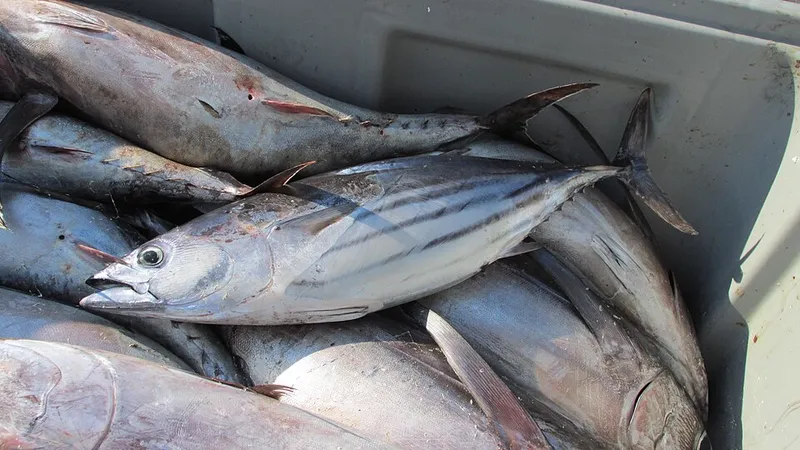
Two different fish in one: the early-summer run heading north on the warm current, and the autumn fish coming back south. The first is lean and fragrant, the second heavy with fat. The party boats run mainly from summer to late autumn.
About
A spindle-shaped fish whose fins, apart from the tail, are all small; the back is deep indigo and the belly silvery white. After death several dark stripes run lengthwise along the belly, while a living, excited fish instead shows dark bars across the body. It migrates along the Kuroshio current, and the early-summer hatsu-gatsuo and autumn modori-gatsuo differ in fattiness. It is the raw material for katsuobushi.
Basics
Scientific name
Katsuwonus pelamis
Family
Scombridae (Mackerels, Tunas, and Bonitos)
Japanese name
カツオ
Kana
かつお
Also called
ホンガツオ, マガツオ, 初ガツオ, 戻りガツオ
Waters
Southern Pacific coast, East China Sea & western Kyushu, Okinawa & Nansei Islands
Size
50 cm (max 100 cm)
Time of day
Dawn, Daytime
Depth (tana)
Surface to mid-water. Working birds and boiling bait mark the school; cast ahead of where it is heading rather than into the middle of it.
Ad slot
How to catch it
Fished mainly from party boats in waters such as Sagami Bay, where chumming with krill is combined with casting jigs and plugs. The season runs from summer to late autumn.
Cast ahead of where the working birds and the boiling bait are heading. Either retrieve fast at the surface or drop the jig and wind it up hard from the bottom. Bleed each fish and ice it the moment it is aboard: skip that and it becomes a cause of histamine poisoning, which cooking does not prevent.
Waters: Southern Pacific coast, East China Sea & western Kyushu, Okinawa & Nansei Islands
Kit for this fish
Shore jigging kit ・ Kit total ¥40,000–100,000
Shore jigging rod, 10 ft, MHLong and powerful enough to cast 40-60 g jigs and to absorb the runs of a hooked jack.¥12,000–40,000AdFind on AmazonFind on Rakuten
Spinning reel, size 4000-5000For shore jigging. A smooth drag under a running fish matters more than anything here, so this is not the place to economise.¥10,000–35,000AdFind on AmazonFind on Rakuten
PE braid, 1.5-2 gouFor shore jigging: the compromise between casting distance and strength.¥2,000–6,000AdFind on AmazonFind on Rakuten
Fluorocarbon leaderThe clear line tied to the end of the braid. It resists abrasion and is less visible, protecting the braid from rock and teeth.¥800–3,000AdFind on AmazonFind on Rakuten
Metal jig, 30-60 gThe mainstay of shore jigging. Carry the same shape in several weights and switch with wind and current.¥600–2,500AdFind on AmazonFind on Rakuten
Landing net with 5 m handlePiers sit high above the water and heavy fish break off if you lift them. Having one changes what you land.¥4,000–20,000AdFind on AmazonFind on Rakuten
Fishing pliers / hook removerEssential protection from venomous spines and sharp teeth. Most injuries happen when someone unhooks a fish bare-handed.¥800–4,000AdFind on AmazonFind on Rakuten
Knife and spike for bleeding fishWhat turns a caught fish into good food; bleeding it changes the taste. See the column "Killing and carrying your catch" for how to use them.¥1,000–6,000AdFind on AmazonFind on Rakuten
Cool box, 15-20 LFor carrying fish home cold. Take plenty of ice; in summer a poorly insulated box is not fit for the job.¥4,000–25,000AdFind on AmazonFind on Rakuten
Life jacket, adult (Japan Craft Inspection approved)The first thing to buy, and worn on piers, rocks and boats alike. Boat fishing requires the government-approved type marked with the cherry-blossom stamp.¥5,000–20,000AdFind on AmazonFind on Rakuten
Studded or felt-soled bootsOrdinary shoes slip on rock and tetrapods. Falls are the most common cause of accidents, so these are mandatory for rocky shores.¥4,000–15,000AdFind on AmazonFind on Rakuten
You will often be on rocks or the tip of a breakwater at dawn, where safety gear matters more than results. Do not go alone.
Product links may be affiliate links. Prices move, so treat the ranges as a guide.
The dark red muscle is high in histidine, which turns to histamine as freshness drops. Thirty minutes to an hour after eating, the face and ears flush and hives and headache follow. Histamine survives cooking, so searing it as tataki is no protection. Bleed and ice the fish immediately and never let it stand at ambient temperature. If your ice will not stretch to the catch, keep fewer fish.
Anisakis larvae occur in this species and raw consumption is a known cause of severe abdominal pain; in 2018 cases traced to bonito taken near the Izu Islands rose sharply across Japan. Gut and chill the fish at once, inspect the flesh closely if you intend to eat it raw, and check the freezing and heating conditions published by Japan's Ministry of Health, Labour and Welfare.
Seared as tataki, raw as sashimi, or simmered. Char the skin over a fierce flame and chill it straight away to bring out the aroma. The bloodline turns quickly, so eat it the same day.
Best eating: May, June, September–November
Rules
On a party boat, follow the skipper's instructions on depth and on when to drop and retrieve. Check the prefectural fishery regulation as well.