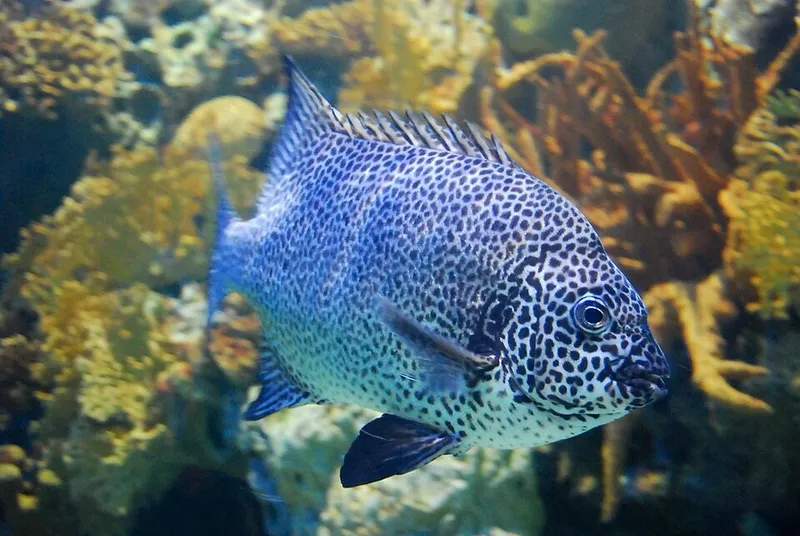
More southerly than the striped knifejaw, and at its best from early summer into autumn as the water warms. It is a bottom fishery on rock marks with strong flow. Old fish go white around the mouth, are called kuchijiro, and are treated as a class apart.
About
A reef fish speckled all over with black spots like a stone wall. It ranges further south than the Barred Knifejaw. With age the mouth turns white, earning it the name kuchijiro, or white lips.
Basics
Scientific name
Oplegnathus punctatus
Family
イシダイ科
Japanese name
イシガキダイ
Kana
いしがきだい
Also called
クチジロ, イシガキ
Waters
Southern Pacific coast, East China Sea & western Kyushu, Okinawa & Nansei Islands
Size
45 cm (max 80 cm)
Time of day
Dawn, Daytime
Depth (tana)
On the bottom, tight to submerged rock and the gaps in the reef. Moving the bait a metre changes the result.
Ad slot
How to catch it
Targeted from rocky shores with strong current using a bottom rig baited with sea urchin such as gangaze. Anglers use a 5-5.4m ishidai rod with a conventional reel, and the season runs from spring to autumn.
A bottom fishery: place a sea urchin such as gangaze against submerged rock, set the rod in a holder, and wait. The urchins and shellfish used as bait are usually covered by fishery rights, so buy them or obtain permission. On a mark you reach by boat, a life jacket and spiked boots are the baseline, and you do not go alone.
Waters: Southern Pacific coast, East China Sea & western Kyushu, Okinawa & Nansei Islands
Kit for this fish
Surf casting kit ・ Kit total ¥22,000–60,000
Surf rod, 4.25 m, 27-gouA true surf rod for launching heavy sinkers to distant ground. Always check behind you before casting.¥8,000–30,000AdFind on AmazonFind on Rakuten
Spinning reel, size 3000For surf casting and live-bait fishing: holds more line and stands up to mid-sized fish.¥5,000–18,000AdFind on AmazonFind on Rakuten
Nylon line, 3-gou (about 12 lb)For sabiki and hole fishing. Thick enough to resist abrasion on rock and to horse a rockfish straight up.¥600–2,000AdFind on AmazonFind on Rakuten
Jet tenbin sinker, 15-25 gouThe long-range sinker for surf casting. It lifts as you retrieve, which reduces snags.¥300–900AdFind on AmazonFind on Rakuten
Whiting rig (2-3 hooks)A surf rig of small, fine-wire hooks matched to the small mouth of Japanese whiting.¥300–900AdFind on AmazonFind on Rakuten
Flounder rig (single-arm sinker, 2 hooks, attractor beads)A winter surf rig; the fluorescent beads make it visible in coloured water.¥400–1,200AdFind on AmazonFind on Rakuten
Aoisome (green sandworm / Nereis)The most versatile worm bait, usable for chonage, surf, hole and float fishing alike. Its movement is the attraction, so do not cut it too short.¥500–1,200AdFind on AmazonFind on Rakuten
Rod stand / tripodFor resting a rod during surf fishing. A rod laid on the ground damages its guides and can be washed away.¥2,000–10,000AdFind on AmazonFind on Rakuten
Cool box, 15-20 LFor carrying fish home cold. Take plenty of ice; in summer a poorly insulated box is not fit for the job.¥4,000–25,000AdFind on AmazonFind on Rakuten
Life jacket, adult (Japan Craft Inspection approved)The first thing to buy, and worn on piers, rocks and boats alike. Boat fishing requires the government-approved type marked with the cherry-blossom stamp.¥5,000–20,000AdFind on AmazonFind on Rakuten
Cap and polarised sunglassesAlso safety equipment, protecting your eyes from a flying rig. Polarised lenses additionally let you read the bottom.¥2,000–20,000AdFind on AmazonFind on Rakuten
You are swinging a heavy sinker, so checking behind you and keeping distance from others is the core of safety here. The cap and glasses are included as eye protection.
Product links may be affiliate links. Prices move, so treat the ranges as a guide.
Large fish grown on southern reefs have been recorded in Japan as carrying ciguatoxin accumulated through their food. Poisoning brings numbness of the mouth and limbs, diarrhoea and joint pain, along with a reversal of temperature sensation in which cold objects feel like an electric shock, and recovery can take a long time. The toxin is not destroyed by cooking and cannot be seen or tasted. Larger fish are considered the riskier ones, so do not take a big specimen home, and check whether any advisory has been issued for the area you are fishing. Seek medical care if you feel unwell after eating.
As with the striped knifejaw, the teeth are fused into plates strong enough to crush sea urchins and turban shells. A finger placed inside can be injured to the bone, so always unhook it with pliers.
This fish has toxic parts, so no preparation advice is given. Pufferfish handling requirements vary by prefecture. Follow Ministry of Health guidance and never prepare a self-caught pufferfish as an amateur.
Rules
The sea urchins and shellfish used as bait are usually covered by fishery rights, and taking them yourself can be an offence, so buy your bait or obtain the cooperative's permission. Access to the marks themselves is normally controlled by a ferry operator.