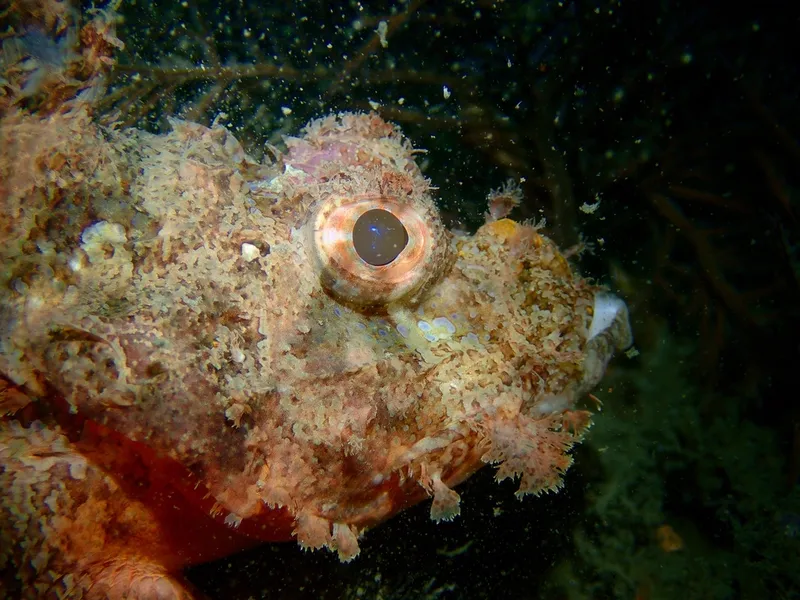
A rockfish of shallow reef, present all year and met by accident while searching for something else. It is commonest in the shallows when the water is warm, which is also when you are most likely to meet one.
About
A scorpionfish of around 20 cm whose reddish body bristles with spines and countless skin flaps, letting it sit disguised among rock and weed and ambush its prey. The dorsal spines are venomous and a sting brings fierce pain. Confusingly, the onikasago that Japanese anglers target in deeper water is usually a different species, the izukasago.
Basics
Scientific name
Scorpaenopsis cirrosa
Family
Scorpaenidae (Scorpionfishes)
Japanese name
オニカサゴ
Kana
おにかさご
Waters
Southern Pacific coast
Size
20 cm (max 30 cm)
Time of day
Dawn, Daytime, Dusk
Depth (tana)
Hard on the bottom, waiting motionless in a hollow or against the weed, so it is the angler who does the searching.
Ad slot
How to catch it
Normally a bycatch when fishing shallow reefs for other rockfish. Never grip it bare-handed, and mind the venomous spines when taking the hook out.
Anazuri (hole fishing in tetrapods) from a Rocky shore
It comes up without warning while you are working holes and weed edges for scorpionfish. Do not swing it about: put it on the ground, pin it with a grip, and take the hook out with pliers. The venom stays active after the fish dies, so neither the fish nor any spine you cut off should be left lying there.
Waters: Southern Pacific coast
Kit for this fish
Hole fishing kit ・ Kit total ¥12,000–28,000
Short hole-fishing rod, 1.2 mA short rod for dropping straight into gaps in the tetrapods. It is easy to handle and stiff enough to pull a fish out before it reaches its hole.¥2,000–6,000AdFind on AmazonFind on Rakuten
Spinning reel, size 1000-2000A small reel for chonage, hole fishing and light work. Light enough for a child to hold.¥2,500–8,000AdFind on AmazonFind on Rakuten
Nylon line, 3-gou (about 12 lb)For sabiki and hole fishing. Thick enough to resist abrasion on rock and to horse a rockfish straight up.¥600–2,000AdFind on AmazonFind on Rakuten
Burakuri (weighted single-hook jig), 3-8 gouA one-piece weight-and-hook rig for hole fishing. Drop it into a gap, tap the bottom, and draw the rockfish out.¥200–600AdFind on AmazonFind on Rakuten
Cut fish bait (saury, mackerel, sardine)For hole fishing, cutlassfish and larger rockfish. Salting the flesh firms it so it stays on the hook.¥300–900AdFind on AmazonFind on Rakuten
Fishing pliers / hook removerEssential protection from venomous spines and sharp teeth. Most injuries happen when someone unhooks a fish bare-handed.¥800–4,000AdFind on AmazonFind on Rakuten
Studded or felt-soled bootsOrdinary shoes slip on rock and tetrapods. Falls are the most common cause of accidents, so these are mandatory for rocky shores.¥4,000–15,000AdFind on AmazonFind on Rakuten
Life jacket, adult (Japan Craft Inspection approved)The first thing to buy, and worn on piers, rocks and boats alike. Boat fishing requires the government-approved type marked with the cherry-blossom stamp.¥5,000–20,000AdFind on AmazonFind on Rakuten
The cheapest tackle but the most dangerous footing. Do not skip the studded boots or the life jacket, and never step on wet tetrapods.
Product links may be affiliate links. Prices move, so treat the ranges as a guide.
Its fin and gill-cover spines are regarded as venomous and a puncture may cause severe pain. Do not handle it bare-handed, even after death; use a fish grip and pliers. If stung, clean the wound and seek medical advice.
The flesh itself is not toxic, and the firm white meat suits simmering or a soup. It can only be handled once every venomous spine has been cut away, and the severed spines need disposing of with just as much care.
Best eating: January, February, November, December
Rules
Check the local fishery regulation. Leaving a venomous fish on the rocks or the pier injures other anglers and is a direct cause of spots being closed. Either take it away or return it to the sea.