Months for Daggertooth Pike-conger are a broad Japan-wide guide and shift with region, temperature and conditions; prefer local reports and rules.
About
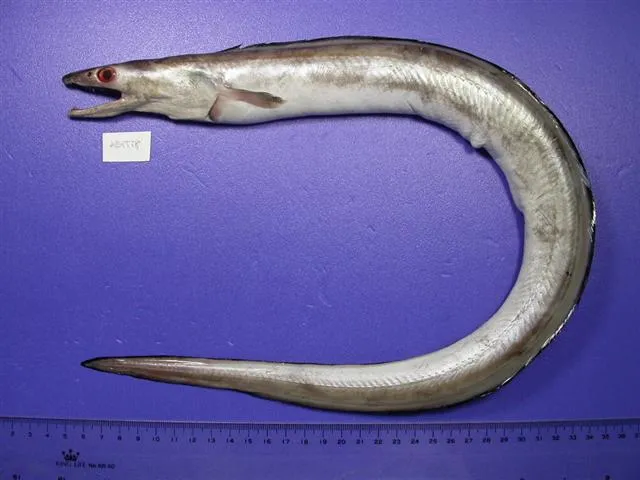
Its mouth splits back past the eye, the snout is long and pointed, and rows of fang-like teeth line the jaws. Brown above and white below, it has none of the conger's white spots. Most are about a metre long, though some exceed two. Fine bones run all through the flesh, so a knife technique called honekiri is essential — the signature of summer cooking in Kyoto.
Basics
Scientific name
Muraenesox cinereus
Family
ハモ科
Japanese name
ハモ
Kana
はも
Waters
Seto Inland Sea, Southern Pacific coast, East China Sea & western Kyushu
Size
80 cm (max 220 cm)
Time of day
Dawn, Daytime
Depth (tana)
Near bottom, using short lifts matched to the seabed.
Daggertooth Pike-conger: Remove slack after bottom contact, lift clear and work short movements. Release small fish carefully.
Waters: Seto Inland Sea, Southern Pacific coast, East China Sea & western Kyushu
Kit for this fish
Dropper-rig starter kit ・ Kit total ¥14,000–36,000
1.8 m dropper-rig rodShort rod for pier or boat dropper rigs; match sinker rating to local or boat instructions.¥3,500–14,000AdFind on AmazonFind on Rakuten
Spinning reel, size 2500The most versatile size for pier fishing: one reel covers sabiki, float fishing and eging.¥4,000–15,000AdFind on AmazonFind on Rakuten
PE braid, 1.0-gouFor wind fishing for cutlassfish and small jacks. The quarry has teeth, so always finish with wire or a heavy leader.¥1,500–5,000AdFind on AmazonFind on Rakuten
Two- or three-hook dropper rigReady-made bottom rig; choose hook size for the target and bait.¥300–1,200AdFind on AmazonFind on Rakuten
Cut fish bait (saury, mackerel, sardine)For hole fishing, cutlassfish and larger rockfish. Salting the flesh firms it so it stays on the hook.¥300–900AdFind on AmazonFind on Rakuten
Fishing pliers / hook removerEssential protection from venomous spines and sharp teeth. Most injuries happen when someone unhooks a fish bare-handed.¥800–4,000AdFind on AmazonFind on Rakuten
Cool box, 15-20 LFor carrying fish home cold. Take plenty of ice; in summer a poorly insulated box is not fit for the job.¥4,000–25,000AdFind on AmazonFind on Rakuten
Life jacket, adult (Japan Craft Inspection approved)The first thing to buy, and worn on piers, rocks and boats alike. Boat fishing requires the government-approved type marked with the cherry-blossom stamp.¥5,000–20,000AdFind on AmazonFind on Rakuten
Where the boat operator specifies sinker and rig sizes, follow those instructions.
Product links may be affiliate links. Prices move, so treat the ranges as a guide.