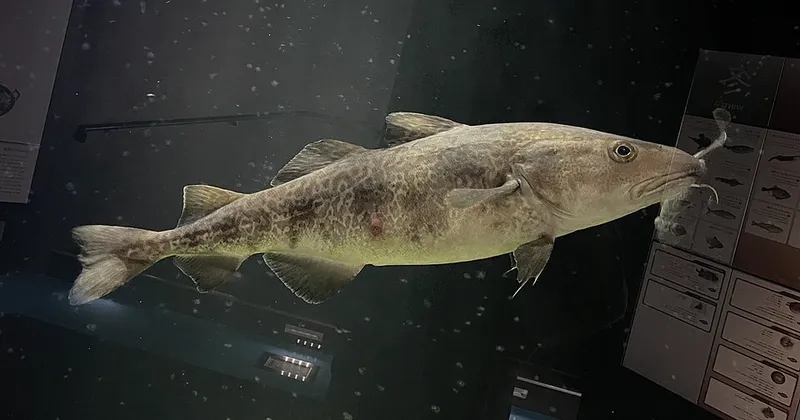
From late autumn into spring, colder water brings Pacific cod shallower and within reach of boats off Hokkaido and northern Honshu.
About
A large northern fish with a single barbel on the lower jaw and an upper jaw that juts past the lower one; the brown body is mottled along the back. It reaches 120 cm and 23 kg, the largest of Japan's three cods. Its huge appetite is why the phrase tarafuku, "eating one's fill", is written in Japanese with the characters for cod and belly. The milt is called kiku for its chrysanthemum-like shape, or tachi in Hokkaido, and is a delicacy.
Basics
Scientific name
Gadus macrocephalus
Family
タラ科
Japanese name
マダラ
Kana
まだら
Also called
タラ
Waters
Hokkaido & Sea of Okhotsk, Sea of Japan, Northern Pacific coast
Size
60 cm (max 120 cm)
Time of day
Dawn, Daytime
Depth (tana)
Within five metres of the bottom. Take up slack as soon as the jig lands and keep it just clear of rough ground.
Local names
寒だら
Ad slot
How to catch it
Almost always taken from boats, either on cut mackerel bait or with heavy jigs. Off Hokkaido and the Sanriku coast, winter and early spring bring the fish into shallower water.
Confirm bottom and work within five metres of it with controlled lifts. Drop and retrieve on the skipper's signal.
Waters: Hokkaido & Sea of Okhotsk, Sea of Japan, Northern Pacific coast
Kit for this fish
Shore jigging kit ・ Kit total ¥40,000–100,000
Shore jigging rod, 10 ft, MHLong and powerful enough to cast 40-60 g jigs and to absorb the runs of a hooked jack.¥12,000–40,000AdFind on AmazonFind on Rakuten
Spinning reel, size 4000-5000For shore jigging. A smooth drag under a running fish matters more than anything here, so this is not the place to economise.¥10,000–35,000AdFind on AmazonFind on Rakuten
PE braid, 1.5-2 gouFor shore jigging: the compromise between casting distance and strength.¥2,000–6,000AdFind on AmazonFind on Rakuten
Fluorocarbon leaderThe clear line tied to the end of the braid. It resists abrasion and is less visible, protecting the braid from rock and teeth.¥800–3,000AdFind on AmazonFind on Rakuten
Metal jig, 30-60 gThe mainstay of shore jigging. Carry the same shape in several weights and switch with wind and current.¥600–2,500AdFind on AmazonFind on Rakuten
Landing net with 5 m handlePiers sit high above the water and heavy fish break off if you lift them. Having one changes what you land.¥4,000–20,000AdFind on AmazonFind on Rakuten
Fishing pliers / hook removerEssential protection from venomous spines and sharp teeth. Most injuries happen when someone unhooks a fish bare-handed.¥800–4,000AdFind on AmazonFind on Rakuten
Knife and spike for bleeding fishWhat turns a caught fish into good food; bleeding it changes the taste. See the column "Killing and carrying your catch" for how to use them.¥1,000–6,000AdFind on AmazonFind on Rakuten
Cool box, 15-20 LFor carrying fish home cold. Take plenty of ice; in summer a poorly insulated box is not fit for the job.¥4,000–25,000AdFind on AmazonFind on Rakuten
Life jacket, adult (Japan Craft Inspection approved)The first thing to buy, and worn on piers, rocks and boats alike. Boat fishing requires the government-approved type marked with the cherry-blossom stamp.¥5,000–20,000AdFind on AmazonFind on Rakuten
Studded or felt-soled bootsOrdinary shoes slip on rock and tetrapods. Falls are the most common cause of accidents, so these are mandatory for rocky shores.¥4,000–15,000AdFind on AmazonFind on Rakuten
You will often be on rocks or the tip of a breakwater at dawn, where safety gear matters more than results. Do not go alone.
Product links may be affiliate links. Prices move, so treat the ranges as a guide.