Months for Chum Salmon are a broad Japan-wide guide and shift with region, temperature and conditions; prefer local reports and rules.
About
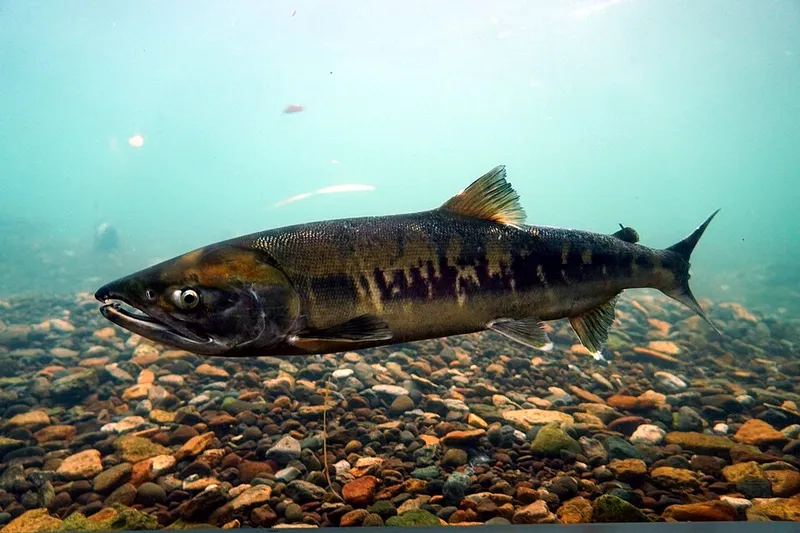
The fish Japanese simply call "salmon." At sea it is silvery, with pale radiating streaks across the tail fin. After several years in the ocean it returns to the river where it hatched; at spawning time a reddish-brown mottling called buna spreads over its flanks and males develop hooked jaws. Its roe is sold as sujiko and ikura.
Basics
Scientific name
Oncorhynchus keta
Family
Salmonidae (Salmons, Trouts, and Whitefishes)
Japanese name
シロザケ
Kana
しろざけ
Waters
Hokkaido & Sea of Okhotsk, Northern Pacific coast, Sea of Japan, Rivers & lakes
Size
50 cm (max 90 cm)
Time of day
Dawn, Daytime
Depth (tana)
In migration channels, but only where an authorised fishery or programme permits capture.
Local names
アキアジ, イヨボヤ
Ad slot
How to catch it
In Hokkaido, autumn akiaji fishing is a local institution: anglers work beaches and river mouths with a float-and-lure rig or a bottom rig, mainly in September and October. Taking salmon within rivers is prohibited.
Freshwater lure fishing from a River / Mountain stream
Chum Salmon: Ordinary river angling is prohibited for some runs and regions. Confirm whether capture is legal with authorities and the cooperative before choosing tackle.
Waters: Hokkaido & Sea of Okhotsk, Northern Pacific coast, Sea of Japan, Rivers & lakes
Kit for this fish
Freshwater lure starter kit ・ Kit total ¥17,000–50,000
6.6 ft ML freshwater lure rodVersatile spinning rod for bass and medium or small trout.¥6,000–22,000AdFind on AmazonFind on Rakuten
Spinning reel, size 2500The most versatile size for pier fishing: one reel covers sabiki, float fishing and eging.¥4,000–15,000AdFind on AmazonFind on Rakuten
8 lb fluorocarbon lineGeneral freshwater lure line; adjust strength for cover.¥800–2,400AdFind on AmazonFind on Rakuten
Freshwater minnow and soft lureFish- or crustacean-shaped lures; check water-specific tackle restrictions.¥600–2,500AdFind on AmazonFind on Rakuten
Fishing pliers / hook removerEssential protection from venomous spines and sharp teeth. Most injuries happen when someone unhooks a fish bare-handed.¥800–4,000AdFind on AmazonFind on Rakuten
Cap and polarised sunglassesAlso safety equipment, protecting your eyes from a flying rig. Polarised lenses additionally let you read the bottom.¥2,000–20,000AdFind on AmazonFind on Rakuten
Life jacket, adult (Japan Craft Inspection approved)The first thing to buy, and worn on piers, rocks and boats alike. Boat fishing requires the government-approved type marked with the cherry-blossom stamp.¥5,000–20,000AdFind on AmazonFind on Rakuten
First check the permit, lure and hook rules, and handling requirements for invasive fish.
Product links may be affiliate links. Prices move, so treat the ranges as a guide.
Food use varies locally. Check harvest rules and water quality, avoid raw consumption and cook thoroughly.
Best eating: September–November
Rules
River capture of salmonids is often closed to ordinary anglers. Fish only in an authorised area, programme or facility, and confirm permits, closed seasons, minimum sizes and legal capture with the prefecture and cooperative.